


An Introduction to Liam and Functional Neurological Disorder
I am pleased to have Liam Virgo on the blog today — but not glad that he has to live with the poorly understood medical condition, Functional Neurological Disorder (FND), previously known as "conversion disorder".
*Disclaimer: This article is meant for educational purposes, and is based on the patient(s)' personal experiences. I am not a doctor, and nothing in this article should be substituted for medical advice. Please consult your own doctor before changing or adding any new treatment protocols. This post may also contain affiliate links. It will cost you nothing to click on them. I will get a small referral fee from purchases you make, which helps with the maintenance of this blog. Read our Privacy Policy page for more information. Thank you!
Pin to Your Functional Neurological Disorder & Rare Disease Boards:

More About FND
Functional Neurological Disorder (FND) is a "condition in which there is a problem with how the brain receives and sends information to one or more parts of the body" ((National Library of Medicine [NLM], 2024). From moving to walking, speaking, and even feeling and thinking — the impacts of FND range far and wide within the human body (Massachusetts General Hospital, n.d.).
In addition, FND can branch out into subtypes, such as functional seizures and Functional Movement Disorder (FMD). FMD in itself can be further classified into different types based on diagnostic features, including dystonia, jerks, tremors, a disruption to gait and balance, limb weakness and/or other generic motor dysfunctions (Hallett et al., 2022).
All combined, this makes FND challenging to diagnose, with no one-size-fits-all treatment plan.
What Liam Will be Sharing with Us Today
For this guest post, Liam will share his personal experiences with FND — from his initial diagnosis, to how he's living with it today. On a side note, I am happy to have another male voice on the blog, as I personally believe that there are not enough perspectives and resources by and for them out there. FND in itself predominantly affects females as well at 60 to 80% (Hallett et al., 2022).
Without further ado, let's read what Liam has to say below!
My Name is Liam, and This is My FND Story
When I was a child, I acquired a debilitating chronic illness that would have a major impact on my life for years to come. I went from being a healthy child to one who couldn’t move or even speak. FND suddenly took my mobility and speech and placed me in a wheelchair, then caused me to become bedridden and locked inside my own mind and body.
My name is Liam, and I’ve been battling with FND since 2016, when I was 13 years old. This is my story which I’m pleased to be sharing with A Chronic Voice.
The Beginning Signs & Symptoms of My FND
I personally had severe FND, and my symptoms were mainly in the form of paralysis, cognitive and speech problems. My physical and cognitive skills deteriorated to the point where I had all my abilities taken away from me.
Within a few days, I had lost my ability to walk and talk, and was rushed to hospital. The doctors were baffled by my mystery illness, and said that I had an unknown disorder. They even filmed my case for medical research for universities around the world. I had so many scans, tests and medical procedures, yet all the results came back as "normal".
I had to leave school as it wasn’t safe for me anymore, due to my sudden deterioration. I don’t remember the early days of my illness, and life before it is a blur.
My Functional Neurological Disorder Diagnosis
After spending 4 months in the hospital, I was finally diagnosed with severe Functional Neurological Disorder. I had at least 20 health professionals involved in my care from across different specialties.
For 6 months my mind was blank, and I didn’t know what or who anything was. As my brain's function improved slowly, it was then that I could understand what was happening to me.
Another Blow from FND, Just as I was Recovering
In the midst of regaining function, FND struck again, causing me to lose the ability to sit up. I was given different types of wheelchairs, but nothing was suitable due to my deteriorating posture.
It got to the stage where my body couldn't tolerate being on any form of equipment apart from my hospital bed. I was bedridden for 3 years and I felt trapped inside my own body, and uncertain about my future.
I wasn't able to talk for a whole year either, but slowly began to regain my voice with determination, and also with the support of my loved ones. The process was painfully slow, but I was determined. With the help of speech and language therapists, slowly but surely, my voice recovered fully.
My FND Recovery Process & The Dream That Motivated My Progress
During the time when I was bedridden, I found comfort in a few things, one of which was London. I saw London on the TV one day while I was bed bound, and thought that I would love to visit it one day. Severe FND meant that I wasn't well enough to go, but it became a dream of mine regardless.
The CAMHS (Child and Adolescent Mental Health Service) and a specialist team from Great Ormond Street Hospital created a progress chart that would help motivate me to achieve my dreams. I would get a point on the chart whenever I moved an arm or finger, which meant that I was one step closer to achieving my wishes.
Learning How to Sit Up on My Own Again
After 3 long years, my body felt less stiff as my FND started to improve. I had to relearn how to move my arms and managed to do so within a few months, which was a huge milestone for me.
Next, I had to learn how to sit up on my own again. One morning, when my back didn't feel as "locked" and stiff, I was transferred to the specialist tilt-in-space wheelchair. This is a special wheelchair where the seat and backrest can be adjusted to different angles, and is used for many different rehabilitative purposes (Giesbrecht et al., 2011; Zemp et al., 2019). Even though I could only lift my head slightly above my knees, it was a huge achievement.
I was transferred to the chair every day for 10 minutes, which was the maximum amount of time my body could tolerate sitting. I would then need to lie down in bed again. However, just being able to sit in the chair for 10 minutes was another huge milestone. Before that, I wasn't able to tolerate sitting on anything for even one second. Slowly but surely, my body regained strength, and I could tolerate sitting in an upright position after many months.
My First Taste of Freedom Again After FND Rehabilitation
At this juncture, I was given a new wheelchair. It was a tilt-in-space one that had self-propelling wheels, so I could wheel myself if I was able to. My first outing in years was to go and collect it from the hospital. It was only the hospital, but to me, it felt like a whole new world ready to explore.
I tasted freedom at last, after having been trapped inside my own body and bedridden for so long. This was now my new life — learning to live with FND. I could no longer remember what the world was like before my FND diagnosis, but I now looked at it differently through the lens of a wheelchair user.
Achieving My Dream of Visiting London
When I was well enough, I achieved my dream of visiting London. It is my favourite place, and I’ve been back many times since. It was everything as I had seen, heard and imagined it to be. I love everything about the city — all the buildings, statues, views and more. My next wish is to visit Cyprus.
A New Chapter with FND — The Start of My Advocacy Work
9 years on from my life-changing illness, I’m learning to walk again. I still have difficult days, but I’m determined to raise awareness about Functional Neurological Disorder and not let it define me.
I'm now committed to living my life to the fullest despite my chronic illness. I've discovered a new purpose in raising awareness about FND. I'm grateful for the progress I've made and excited for what’s to come. I'm not letting my FND define me — I'm living life on my own terms.
Despite the harrowing experiences with severe FND where it took my voice, body and freedom, I found the strength and resilience to fight through it from somewhere within. It’s been a long, painful and isolating journey, but I’m learning to live with FND — and I’m determined to never give up hope for the future. I believe that even when all feels lost, you can still find a way forward. If you’re living with FND, know that you are not alone.
Pin to Your Functional Neurological Disorder (FND) & Chronic Illness Boards:
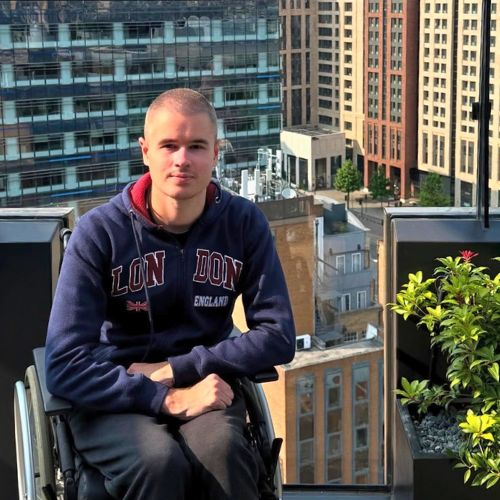
I'm Liam Virgo, and my life took an unexpected turn in 2016 when I was just 13 years old. I was diagnosed with severe Functional Neurological Disorder and became bedridden. It's been a challenging journey, but I'm determined to live life to the fullest. My condition may have taken away my mobility and speech, but now it's also given me a voice to speak up about FND. Connect with me on Instagram.
- MedLine Plus. (20 October, 2024.) Functional neurological disorder. https://medlineplus.gov/ency/article/000954.htm
- Giesbrecht, E. M., Ethans, K. D., & Staley, D. (2011). Measuring the effect of incremental angles of wheelchair tilt on interface pressure among individuals with spinal cord injury. Spinal Cord, 49(7), 827–831. https://doi.org/10.1038/sc.2010.194
- Hallett, M., Aybek, S., Dworetzky, B. A., McWhirter, L., Staab, J. P., & Stone, J. (2022). Functional neurological disorder: New subtypes and shared mechanisms. The Lancet Neurology, 21(6), 537–550. https://doi.org/10.1016/S1474-4422(21)00422-1
- Massachusetts General Hospital. (n.d.). Basics of functional neurological disorder (FND). Retrieved 2 December 2025, from https://www.massgeneral.org/neurology/treatments-and-services/functional-neurological-disorder-basics
- National Library of Medicine. (2024, October 20). Functional neurological disorder. MedlinePlus. https://medlineplus.gov/ency/article/000954.htm
- Zemp, R., Rhiner, J., Plüss, S., Togni, R., Plock, J. A., & Taylor, W. R. (2019). Wheelchair tilt-in-space and recline functions: Influence on sitting interface pressure and ischial blood flow in an elderly population. BioMed Research International, 2019(1), 4027976. https://doi.org/10.1155/2019/4027976


Member comments