> ## Content Index
> Fetch the complete content index at: https://achronicvoice.com/llms.txt
> Use this file to discover other available public pages before exploring further.
# How to Use the 7 Dimensions of Wellness to Thrive with Chronic Pain
- URL: https://achronicvoice.com/dimensions-of-wellness-thrive-chronic-pain/
- Published: 2021-05-24T02:00:47.000Z
- Updated: 2026-04-02T16:42:52.000Z
- Author: Sheryl Chan
- Tags: Chronic Illness, Home & Lifestyle, Self-Care, Mental Health, Personal Development
This article explores the 7 dimensions of wellness and how we can use them to improve our quality of life despite chronic pain. Those who live with chronic pain know all too well that there is no one-size-fits-all approach to pain management. Even those who live with the same chronic illness often need a mix of different treatment protocols and routines.
All dimensions of wellness are interrelated and important for our wellbeing. Certain suggestions might be repeated in different sections, but the application differs according to the dimension of wellness featured.
Pin to Your Dimensions of Wellness & Chronic Pain Boards:
*\*Disclaimer: Wellness is a mammoth topic; a tribute to the diversity of our humanity. Every patient with a chronic illness or disability is unique, too. The resources and suggestions below are for a general audience. *I am not a medical professional*, but have done extensive research for this post from credible sources. Please take each suggestion with a pinch of salt, and *discuss anything you’d like to try with your doctor first*.*
*Whilst this post is sponsored by Mayv, all opinions expressed are my own. This post may contain affiliate links. It will cost you nothing to click on them. I will get a small referral fee from purchases you make, which helps with the maintenance of this blog. Read the* [***Privacy Policy***](https://achronicvoice.com/privacy-policy/) *page for more information. Thank you!*
## What are the 7 Dimensions of Wellness?
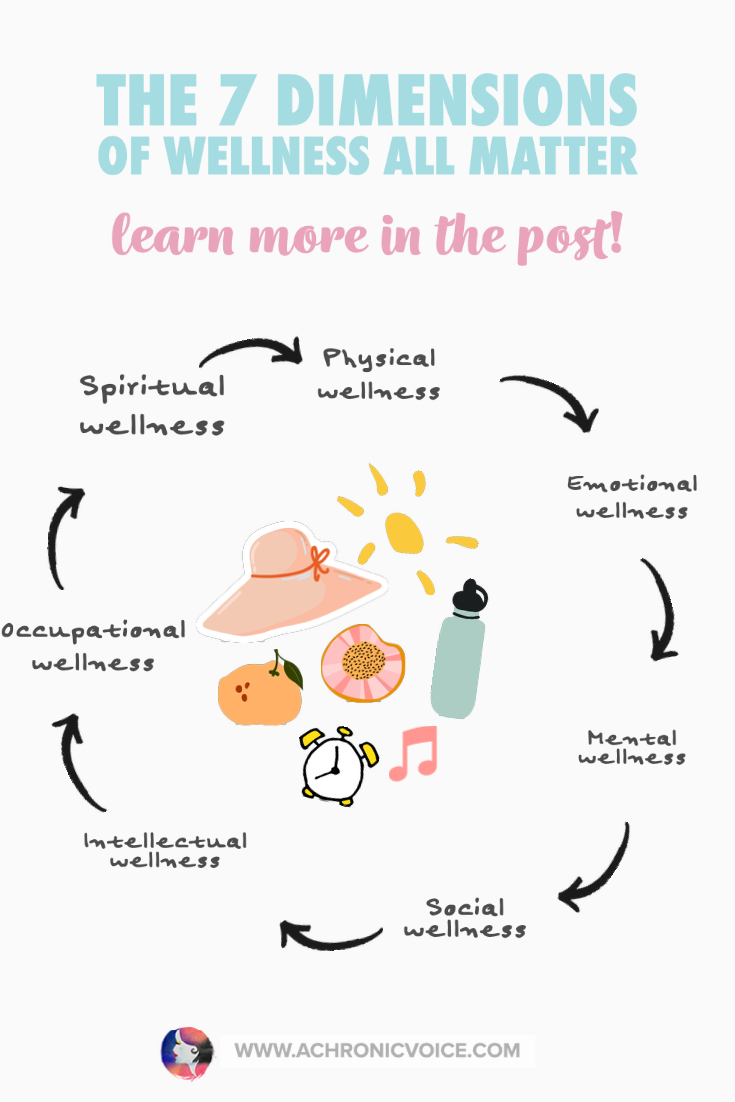
The seven dimensions of wellness include: physical, mental, emotional, spiritual, intellectual, occupational and social wellness. The idea is that our bodies rely on every single one of these dimensions of wellness for optimal health and wellbeing. Each dimension influences the others, for better or for worse.
Kind of like a car. The engine, fuel, steering wheel and more parts need to work in unison so that the car can 'go'. How well and how far it travels is dependent on the quality and maintenance of the sum of its parts.
According to the World Health Organisation, **health is not just an absence of disease**. It requires integration of all seven dimensions of wellness, so that we are **complete and fulfilled as a human being**.
> [“Wellness necessicitates good self-stewardship, for ourselves and those we care about and who care for us….. Wellness … is a personal responsibility.”](https://www.ncbi.nlm.nih.gov/pmc/articles/PMC5508938/) (Stoewen, 2017)
Pin to Your Health & 7 Dimensions of Wellness Boards:
### A Note on Holistic Health vs Holistic Healthcare
> ["Holism also has its origin in the Greek word holos, which means 'whole'..... it is an approach that looks at things in a total perspective."](https://www.sciencedirect.com/science/article/abs/pii/B9780128012826000036) (Patwardhan et al., 2015)
The dimensions of wellness are often interchanged with the term 'holistic health'. Whilst holistic health may encompass holistic healthcare, the reverse may not necessarily be true. We all need to find what works best for us, which can be as different as the sun and moon.
> ["In conclusion, good health care is likely to be holistic but holistic health care, as it is marketed at present, is not necessarily good..... What matters most is whether or not any given approach optimally benefits the patient."](https://www.ncbi.nlm.nih.gov/pmc/articles/PMC2034187/) (Ernst, 2007)
One important thing to note is that these dimensions of wellness are **not** anti-conventional medicine. Rather, they are about making [lifestyle choices that are supportive to healing and wellness in its entirety](https://www.betterhealth.vic.gov.au/health/conditionsandtreatments/complementary-therapies) (Better Health Channel, 2021).
### The Importance of Forming Healthy Habits
All seven dimensions of wellness require discipline, attention and self-compassion. The aim is to form healthy habits that become part of our everyday lives.
The more you practise them, the better you get at accessing these resources when chronic pain strikes. This is because self-regulation is hard as compared to habits. About [40% of our everyday behaviour is habitual](https://www.ncbi.nlm.nih.gov/pmc/articles/PMC5508938/) (Stoewen, 2017) and therefore, has a huge impact on our present and future.
One of my favourite sites for mini courses and resources that help with habit formations based on scientific research is ['Clearer Thinking'](https://www.clearerthinking.org/) (n.d.).
> “We build our character from the bricks of habit we pile up day by day.” - Zig Ziglar
Pin to Your Chronic Pain Management & Self-Care Boards:
## The First Dimension of Wellness – Physical Wellness
Let's begin with physical health, as it's often what we think of first when we mention 'wellness'. This is because it's the easiest to measure as compared to the other dimensions of wellness. It is less abstract, with more tools that are able to give us tangible insight.
Taking care of our bodies is a way of showing respect and appreciation both to ourselves and our loved ones. It is to express gratitude for the miracle of life.
What we choose to nourish ourselves with, and how we maintain our fitness, diet, sleep and appearances; They all have an impact on managing chronic pain and self-esteem to a degree. *(P.s. I love this playlist, 'Student of the Land', on YouTube: ‘*[*Skin & Hair Care for those with Chronic Conditions*](https://www.youtube.com/playlist?list=PL6ooEUG5R1t%5F67ZV8F74rEEUrv%5FTg7N1K)*’. All traditional Indian mother to daughter holistic remedies (Chopra, n.d.)!)*
You may have heard of the quote, 'your body is a temple', and the chronic illness version, 'my body is a temple, ancient and crumbling, probably cursed or haunted'. It's funny because it feels that way ~~sometimes~~ often.
It may feel pointless at times to put in the effort to maintain our bodies and physical health with chronic pain. But healing and wellness go beyond physicality to encompass our entire being. Chronic pain may have limited us in certain ways, but we can still try to live a life of meaning and value.
> “My body is a temple, and my temple needs redecorating.” - Joan Rivers
Pin to Your Health, Wellness & Quote Boards:
### Getting Enough Quality Sleep & Rest
Whilst there are many aspects of our physical health that we need to pay attention to, I’d like to take some time to focus on quality sleep and rest.
They are often sacrificed in the name of ‘productivity’ in a society that glorifies busyness. A culture that emphasises on ‘doing’ and devalues ‘being’.
This is one reason why those with chronic pain feel worthless at times. It's hard not to despair when all you can do is... nothing. Simple, everyday chores take colossal effort. Tasks on your todo list overflow and form a stagnant puddle.
Yet we need to remember that resting and sleeping are actually highly productive for all dimensions of wellness. Our body shifts into [optimal repair and healing mode when we sleep](https://newsinhealth.nih.gov/2021/04/good-sleep-good-health) (NIH News in Health, 2021); modes that cannot be activated when we are awake. This ultimately gives us more fuel to keep going. Life is a marathon after all, and not a sprint.
Quality sleep, however, is also a catch-22 situation. It's hard to fall asleep whilst in the cruel, unrelenting grip of chronic pain. Where you have no say and no choice but can only endure it. Those with chronic illness have even coined a term for it, '[painsomnia](https://creakyjoints.org/acr-2018/painsomnia-tips/)' (Donvito, 2018).
Read Related Posts:
- [How to Have a Healthy Relationship with Your Body (Even with Chronic Illness)](https://achronicvoice.com/healthy-relationship-with-body-chronic-illness/)
- [How Does Antiphospholipid Syndrome Affect The Body? (Beyond the Blood to Major Organs)](https://achronicvoice.com/how-does-antiphospholipid-syndrome-affect-the-body/)
- [40 People with Chronic Illness Share Their Best Pain Management Tips (What to Do if an Unforeseen Pain Flare Hits)](https://achronicvoice.com/pain-management-tips-pain-flare/)
- [How Much Time Are You Wasting On Sleep?](https://achronicvoice.com/wasting-time-sleep/)
- [My Recovery Time for Simultaneous Bilateral Patellar Tendon Rupture (With Lupus & Steroid Treatment)](https://achronicvoice.com/recovery-time-for-simultaneous-bilateral-patellar-tendon-rupture/)
### Holistic Ways to Improve Physical Wellness
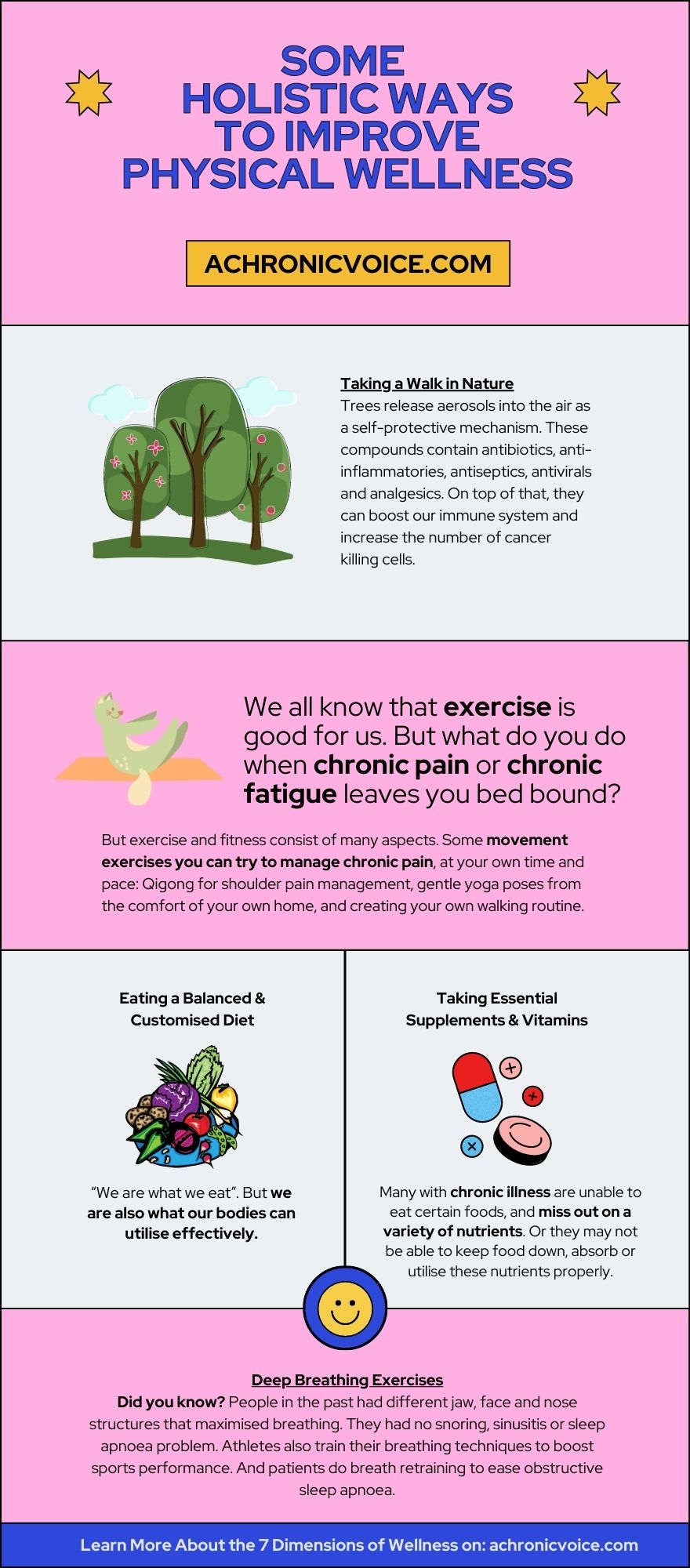
This is not an exhaustive list, but some basic, general suggestions for improving physical wellness:
- **Taking a Walk in Nature**
[Trees release aerosols](https://e360.yale.edu/features/ecopsychology-how-immersion-in-nature-benefits-your-health) into the air as a self-protective mechanism (Robbins, 2020). These compounds contain antibiotics, anti-inflammatories, antiseptics, antivirals and analgesics. On top of that, they can [boost our immune system and increase the number of cancer killing cells](https://pmc.ncbi.nlm.nih.gov/articles/PMC2793341/) (Li, 2010). The power of being close to trees and breathing in the fresh air should not be underestimated. So simple, yet so good for our physical wellness!
- **Exercise & Movement**
We all know that exercise is good for us. But what do you do when chronic pain or chronic fatigue leaves you bed bound? So often I need help to even get from a seated to standing position. But exercise and fitness consist of many aspects. Cardio, weightlifting and crossfit are on one end of the spectrum. But stretching, breathing and [strength training are also important](https://link.springer.com/article/10.1007/s40279-018-0862-z) (Suchomel et al., 2018).
Many [chronic pain patients with arthritis and joint pains are encouraged to do some strength training exercises](https://www.health.harvard.edu/staying-healthy/5-weight-training-tips-for-people-with-arthritis), as this helps to support and protect the joints (Harvard Health Publishing, 2021). Other movement exercises you can try to manage chronic pain, at your own time and pace: Qigong for shoulder pain management, gentle yoga poses from the comfort of your own home, and creating your own walking routine.
- **Eating a Balanced & Customised Diet**
“We are what we eat”, as they say. But we are also what our bodies can utilise effectively. In Ayurvedic medicine, your diet is geared towards optimising your dosha, or body type. Nutritional therapists also recommend different foods for different individuals. (And yes I’ve tried both types of alternative therapies; the insight was interesting to say the least!)
In general, [limiting highly processed foods](https://food-guide.canada.ca/en/healthy-eating-recommendations/limit-highly-processed-foods/) (Health Canada, 2022) and choosing healthier, organic options can help to control inflammation and chronic pain. As they also say, “eat the rainbow”. [Fruits and vegetables of different colours](https://www.health.harvard.edu/blog/phytonutrients-paint-your-plate-with-the-colors-of-the-rainbow-2019042516501) contain various unique antioxidants and nutrients, all of which our body needs for optimal function (McManus, 2019).
- **Taking Essential Supplements & Vitamins**
Many with chronic illness are unable to eat certain foods, and miss out on a variety of nutrients. Or they may not be able to keep food down, absorb or utilise these nutrients properly. Patients like myself often need supplements in addition to their medications.
- **Deep Breathing Exercises**
Deep breathing for physical wellness, really? Yet [athletes train their breathing techniques](https://theconversation.com/how-controlled-breathing-helps-elite-athletes-and-you-can-benefit-from-it-too-128072) to boost sports performance (Shearer, 2019). And some patients do [breath retraining exercises to ease their obstructive sleep apnoea](https://www.sleepfoundation.org/snoring/mouth-exercises-to-stop-snoring) (Suni, 2024).
I am currently reading a book, [“Breath: The New Science of a Lost Art”, by James Nestor](https://www.amazon.com/dp/0593191358?&linkCode=ll1&tag=achronicvoice-20&linkId=ed5e33f67552819a48ad1c21706a94bd&language=en%5FUS&ref%5F=as%5Fli%5Fss%5Ftl) (2020), and found it really astounding to learn that the jaw, nose and facial structures of people in the past were maximised for breathing. People back then had no snoring, sinusisitis or sleep apnoea problems. As a human race, our facial features have actually devolved. The question they are trying to figure out is, “why”?
Read Related Posts:
- [The Causes & Dangers of Malabsorption & An Easy Way to Get Your Nutrients](https://achronicvoice.com/causes-dangers-malabsorption-get-nutrients/)
- [Dysphagia & Swallowing Problems (and How Oral Vitamin Sprays Can be of Help to You)](https://achronicvoice.com/dysphagia-oral-vitamin-sprays/)
- [Oral Spray Vitamins: A Quick & Easy Way to Get Your Nutrients with Chronic Illness](https://achronicvoice.com/oral-spray-vitamins/)
- [Is Yoga Accessible for People with Chronic Illness?](https://achronicvoice.com/accessible-yoga-chronic-illness/)
- [Learn More About the Super Rare Disease – Esophageal Diverticulum](https://achronicvoice.com/rare-disease-esophageal-diverticulum/)
Pin to Your Health, Wellness & Infographic Boards:
## The Second Dimension of Wellness – Mental Wellness
[Mental wellness and emotional wellness](https://www.psychreg.org/dont-say-mental-health/) are sometimes used interchangeably. Emotional wellness refers more to our moods and emotions, whereas mental wellness is more of how our brain functions (Ivey, 2019).
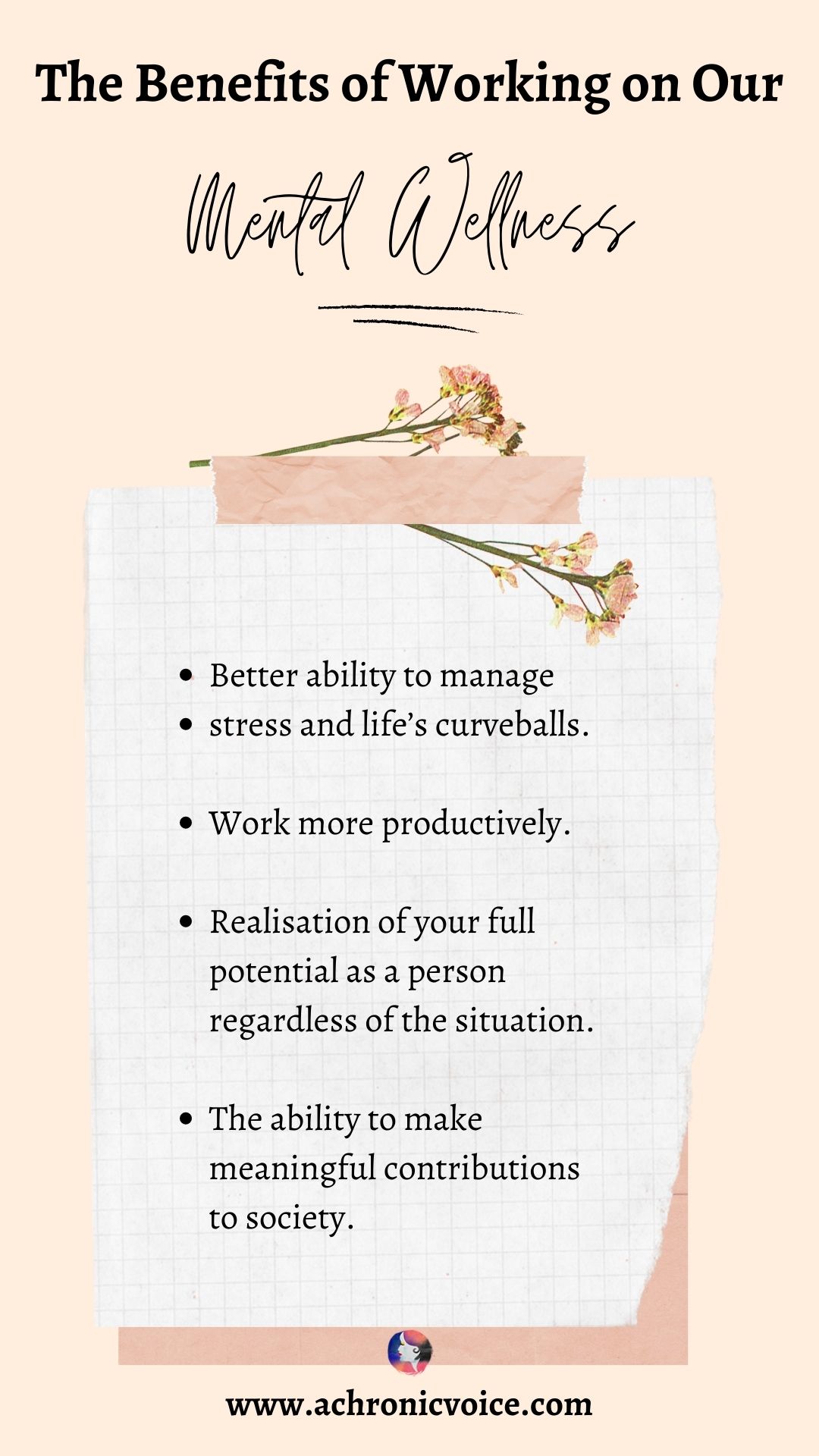
Working on our mental wellness is about doing our best to improve our mental capabilities and cognitive function. In other words, to stretch our mental resilience and shift our mindset in a more positive direction. Doing so has many benefits, such as:
- Better ability to manage stress and life's curveballs
- Work more productively
- Realisation of your full potential as a person regardless of the situation
- The ability to make meaningful contributions to society
Pin to Your Mental Health & Self-Care Boards:
As someone who has been living with clinical depression and anxiety for years, I know just how important mental wellness is. Without it, there is no motivation, drive or hope. As a result, we sometimes let ourselves 'go to waste', as there is no desire to get better, or to do better. The worst part about it? [What we think isn't always true](https://www.psychologytoday.com/intl/blog/emotional-fitness/201310/feelings-aren-t-facts) (Goldsmith, 2013); Learning to make that differentiation can sometimes be the line between life and death.
According to the Trunzo (2019), a clinical psychologist and professor of psychology at Bryant University in Smithfield, Rhode Island:
> “[Be the thinker, not the thought](https://aeon.co/essays/it-takes-psychological-flexibility-to-thrive-with-chronic-illness): this phrase refers to how we handle our internal voice, the constantly running commentary that we experience all day, every day, and can never seem to silence. For whatever reason, that inner voice can be very critical, judgmental or even downright cruel. We also tend to listen to it way too much.”
Pin to Your Mental Health & Awareness Boards:
### Holistic Ways to Improve Mental Wellness
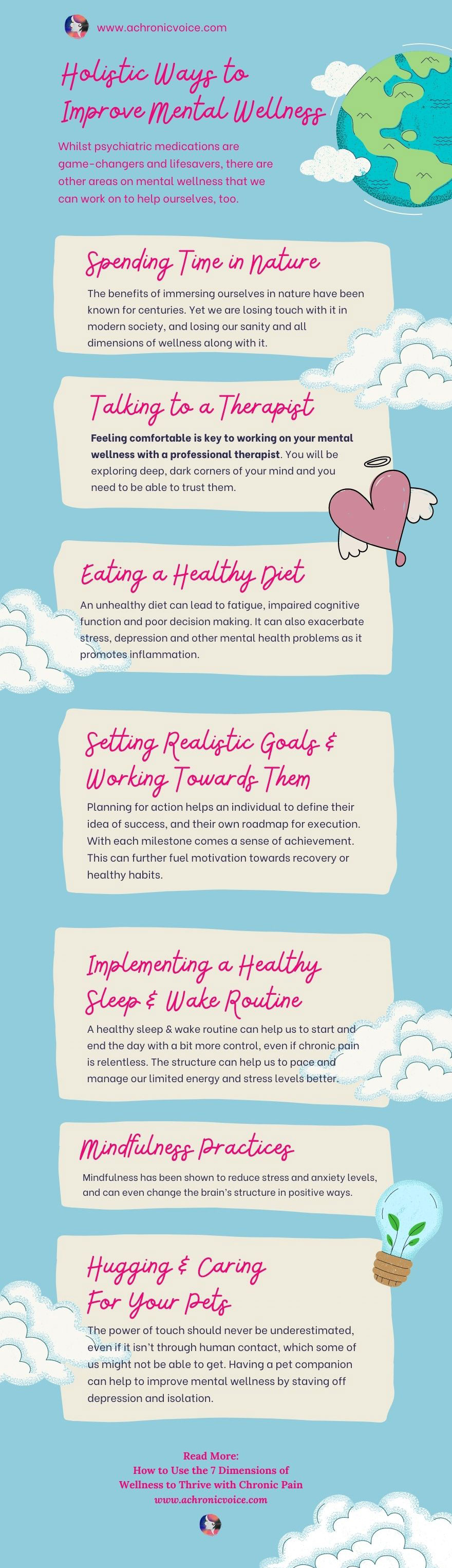
Psychiatric medications have been a game-changer and lifesaver for me. I must take them every day to function properly, but they are not a be-all-and end-all solution. If I do not pay attention to the afflictions on my mental health and take proactive steps, my need for medications will only increase.
A few methods to try and maintain good mental wellness are:
- **Spending Time in Nature**
Dr Qing Li is an environmental immunologist, forest medicine expert, and also the [leader in ‘Forest Bathing’ research](https://lifebeyondnumbers.com/dr-qing-li-forest-bathing-why-you-need/). His studies have shown that the more time we spend closer to trees, the greater the health benefits, such as (Das, 2018):
- Lower adrenaline and cortisol levels (which affects our stress levels)
- Improved T-Cell function (which affects our immune systems)
- Decrease in blood pressure
- Decrease in respiratory rate
The benefits of immersing ourselves in nature have been known for centuries. Yet we are losing touch with it in modern society, and losing our sanity and all dimensions of wellness along with it. Cultural traditions such as ‘[udeskole](https://www.tandfonline.com/doi/abs/10.1080/14729679.2012.699806)’ and ‘[hygge](https://www.visitdenmark.com/denmark/highlights/hygge/what-hygge)’ in Scandinavia (Bentsen & Jensen, 2012; VisitDenmark, n.d.), and ‘[shirin-yoku](https://time.com/5259602/japanese-forest-bathing/)’ (aka forest bathing) in Japan (Li, 2018), are becoming popular again in modern society for these reasons.
Sometimes it can be impossible for those with chronic pain or disability to leave the house, let alone take a leisurely stroll through the woods. In these instances, why not bring nature to you instead? You could do some outdoor or indoor gardening, which also has a positive effect on all dimensions of wellness.
What if you want to enjoy the health benefits and aesthetics of greenery, but want something a little more low-maintenance instead? A terrarium, [air plants](https://www.gardenista.com/posts/10-things-nobody-tells-you-about-air-plants-tillandsias/) (Slatalla, 2022), or these [hard to kill houseplants](https://www.thespruce.com/easy-houseplants-hard-to-kill-4141665) can do the job, too (Iannotti, 2024). And if you're into technology, there are even [smart gardens](https://nymag.com/strategist/article/best-indoor-garden-kits.html) on the market these days (Schwartz, 2025)!
> “In every walk with nature one receives far more than one seeks.” - John Muir
- **Talking to a Professional Therapist**
There are major differences between a psychologist, a psychiatrist and a counsellor, although they all fall under the same umbrella of ‘[mental therapists](https://www.webmd.com/mental-health/guide-to-psychiatry-and-counseling)’ (Bhandari, 2024). In brief, a psychiatrist is a medical doctor who can prescribe medications and treats mental illnesses and disorders. A psychologist has a doctoral degree in psychology, which focusses on the study of the mind and human behaviours. A licensed mental health counsellor has a master’s degree in psychology, counselling or a related field.
Within each profession there are different schools of thoughts and treatments as well. This makes it critical that you do your research before hiring a professional therapist, based on your mental health needs and communication style. I know of many people who have stopped after only a few sessions, because they didn’t feel that it benefitted them. I have personally fired a few psychologists assigned to me by my hospital, because our communication styles were worlds apart.
***Feeling comfortable is key to working on your mental wellness with a therapist***. You will be exploring deep, dark corners of your mind and you need to be able to trust them.
For More Insight, Read:
- [Why You Need a Good Therapist on Your Healthcare Team (Based on My Personal Experiences)](https://achronicvoice.com/why-need-good-therapist/)
- [Is Seeking Help for Your Mental Health Worth It?](https://achronicvoice.com/mental-health-worth-it/)
- [What I’ve Learned – Living with Chronic Illness for 20 Years (Interview on ‘The Uninvisible Pod’)](https://achronicvoice.com/interview-uninvisible-pod/)
- [Clinical Depression: Diagnosed 10 Years Late](https://achronicvoice.com/depression-diagnosed-late/)
- **Improving the Quality of Your Connections & Relationships**
Doing so has many benefits for all dimensions of wellness; In regards to mental wellness, [high quality relationships](https://www.betterhealth.vic.gov.au/health/HealthyLiving/Strong-relationships-strong-health) can stave off loneliness and depression, and increase happiness (Better Health Channel, n.d.).
- **Eating a Varied, Healthy Diet**
An unhealthy, incomplete diet has many consequences on our over all health and mental wellness. It can lead to fatigue, impaired cognitive function and poor decision making. It can also exacerbate stress, depression and other mental health problems as it [promotes inflammation](https://www.health.harvard.edu/blog/5-inflammation-fighting-food-swaps-2021051022570) (Bilodeau, 2021). A healthy diet provides the nutrition our brain and nervous system need to build new proteins, cells and tissues. This consists of a healthy mix of complex carbohydrates, lean proteins, fatty acids and minerals.
According to Harvard Health Publishing (2024), some [foods that will help to boost your mental health](https://www.health.harvard.edu/healthbeat/foods-linked-to-better-brainpower) include:
- Green leafy vegetables such as kale and spinach contain a variety of nutrients for optimal brain health and cognition.
- Fatty fish such as salmon and cod are rich in omega-3 fatty acids and healthy unsaturated fats. These are essential in cleaning up amyloid-beta in our brains, which causes cognitive decline.
- Berries contain flavonoids, which help to improve memory.
- Nuts are packed with protein, fibre, healthy fats, minerals and vitamins. Talk about packing a punch! Here's a great [list of the different types of nuts](https://www.bbcgoodfood.com/howto/guide/health-benefits-nuts) (Torrens, 2024) you can go nuts on (good pun, or no?).
- **Setting Realistic Goals & Working Towards Them**
Goal setting is a common method used in recovery and mental health programmes. Planning for action helps an individual to define their idea of success, and their own roadmap for execution. With each milestone comes a sense of achievement. This can further fuel motivation towards recovery or healthy habits.
SMART goals are a popular method used in a variety of settings due to their effectiveness. In short, SMART stands for:
- S: Specific
- M: Measurable
- A: Attainable
- R: Relevant
- T: Time Bound
You can [read more about SMART goals and use this template for yourself here](https://www.verywellmind.com/smart-goals-for-lifestyle-change-2224097) (Stibich, 2024).
- **Implementing a Healthy Sleep & Wake Routine**
Our brain and body thrive on healthy routines. As mentioned earlier in the article, the formation of healthy habits is key to all dimensions of wellness. Quality sleep is essential in chronic pain management, and [good sleep hygiene](https://www.health.harvard.edu/staying-healthy/sleep-hygiene-simple-practices-for-better-rest) can help our brains to switch off and ease into sleep every night (Solodar, 2025).
A healthy morning routine can help to set the tone for the rest of the day. You could **[do some gentle yoga](https://achronicvoice.com/accessible-yoga-chronic-illness/)** whilst still in bed, read with a cup of coffee, or do some meditation. These routines help us to start and end the day with a bit more control, even if chronic pain is relentless. The structure can help us to pace and manage our limited energy and stress levels better.
- **Mindfulness Practices**
[According to the Mental Health Foundation (2021)](https://www.mentalhealth.org.uk/explore-mental-health/a-z-topics/mindfulness):
> "Mindfulness is a technique you can learn to be fully present and engaged in the moment without judging anything. It can help you manage your thoughts, feelings and mental health."
Mindfulness is an effective coping tool for those with mental health issues. It has been shown to reduce stress and anxiety levels, and can even change the brain's structure in positive ways.
- **Hugging & Caring For Your Pets**
The power of touch should never be underestimated, even if it isn't through human contact, which some of us might not be able to get. Having a [pet companion can help to improve mental wellness](https://www.healthdirect.gov.au/7-ways-pets-improve-your-mental-health) by staving off depression and isolation . Caring for a pet can also positively impact all other dimensions of wellness, such as increasing your social interaction and fitness levels, when you bring them for a walk (Healthdirect Australia, 2023).
For More Insight, Read:
- [A Car Accident & A Song Gone Silent (How Life Lessons from Chronic Illness Tide Me Through)](https://achronicvoice.com/chronic-illness-life-lessons-accident-bird/)
- [Why I Moved from SiteGround to Cloudways (and Couldn’t be Happier). Plus Cute Puppy Pics & A New Pacing Strategy.](https://achronicvoice.com/moved-from-siteground-to-cloudways/)
- [Are You a Capable Person? What Does That Even Mean?](https://achronicvoice.com/capable-person-meaning/)
- [Depression After Knee Surgery & How to Cope](https://achronicvoice.com/depression-after-knee-surgery/)
- [Today is Not a Good Day to Make Decisions (and That’s Okay)](https://achronicvoice.com/today-is-not-a-good-day/)
Read My Post on SubStack:
- [The Way My Dog, Talisker, Brings Me Joy](https://achronicvoice.substack.com/p/the-way-my-dog-talisker-brings-me)
Pin to Your Mental Health, Wellness & Infographics Boards:
## The Third Dimension of Wellness – Emotional Wellness
Emotional wellness is also closely linked to the mental and social dimensions of wellness. It [includes an awareness, respect and acceptance of the ‘self’](https://www.health.harvard.edu/blog/greater-self-acceptance-improves-emotional-well-201605169546) that is rooted in a positive mindset. It is not to suppress or deny ‘bad feelings’, but to understand the value of all our emotions, and what they’re trying to tell us (Harvard Health Publishing, 2016).
Being connected with ourselves can help guide us intuitively towards alignment and purpose. This doesn’t necessarily mean feeling good right away, but to take a step in the right direction for long-term wellness benefits.
> “Thoughts and feelings are like children knocking on the door of the present moment.” —Jeff Foster
### The Benefits of Emotional Wellness
Out of all the dimensions of wellness, emotional wellness probably fluctuates the most. Something annoying can trigger us in a negative way, and a shift in perspective can lift our mood just as quickly.
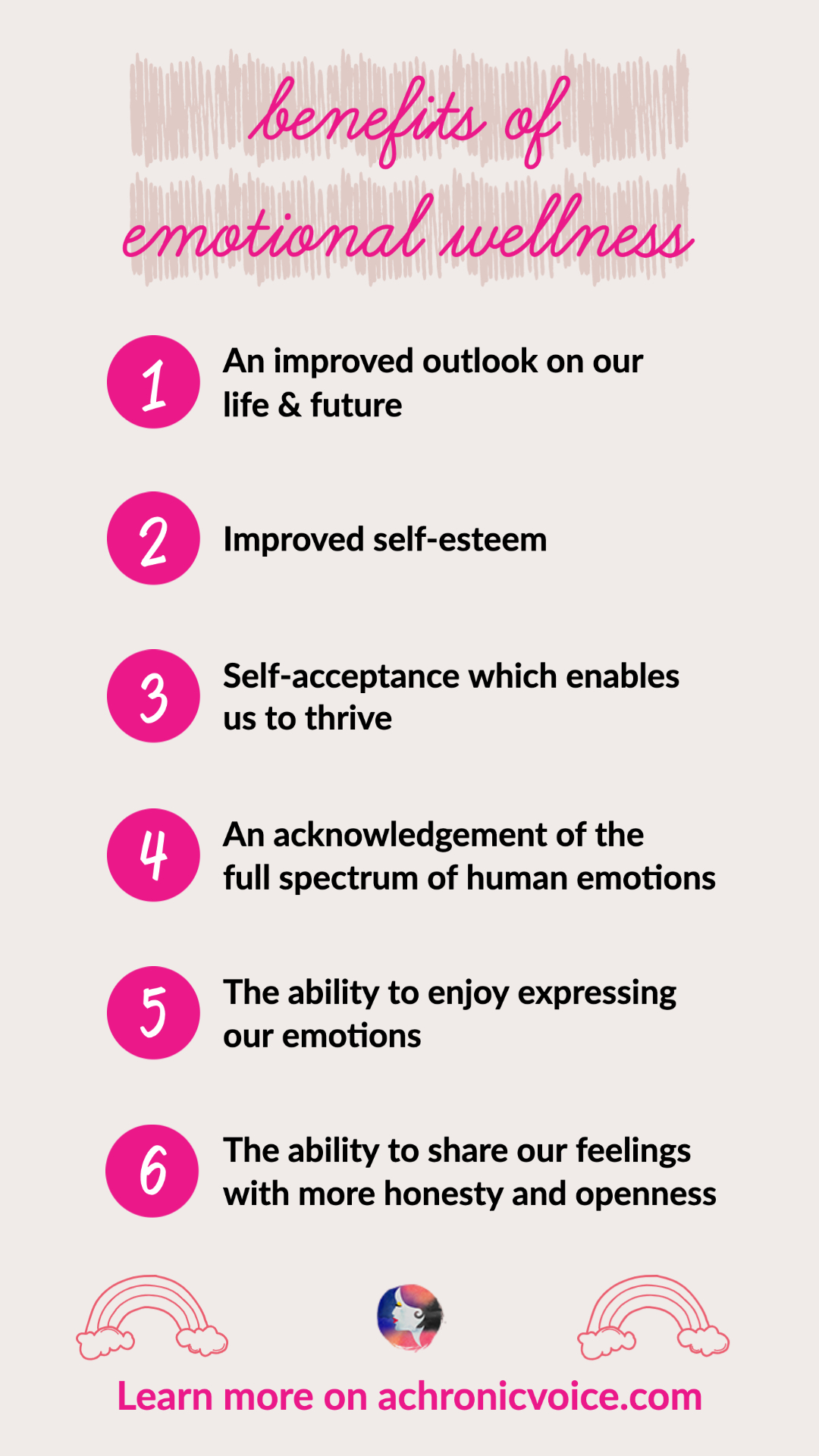
Working on our emotional wellness has benefits, such as:
- An improved outlook on our life and future
- Improved self-esteem
- Self-acceptance which enables us to thrive
- An acknowledgement of the full spectrum of human emotions
- The ability to enjoy expressing our emotions
- The ability to share our feelings with more honesty and openness
Pin to Your Emotional Wellness & Self-Love Boards:
All these elements are necessary for us to feel good about ourselves, and also to connect on a deeper emotional level with others.
> “By throwing yourself into these emotions, by allowing yourself to dive in, all the way, over your head even, you experience them fully and completely.” — Mitch Albom
> "We need to rebrand vulnerability and emotion. A vulnerable man is not some weird anomaly. He is open to being hurt, but also open to love." — Grayson Perry
Read Related Posts:
- [365 Mindfulness Journaling Prompts for Self-Improvement](https://achronicvoice.com/365-mindfulness-journaling-prompts-for-self-improvement/)
- [Grieving the Life That I Will Never Have](https://achronicvoice.com/grieving-the-life-i-will-never-have-chronic-illness-disability/)
- [Uplifting Activities to Do While Recovering in Bed](https://achronicvoice.com/uplifting-activities-to-do-while-recovering-in-bed/)
- [How to be a Positive Thinker: Without the Unicorns & Rainbows](https://achronicvoice.com/positive-thinker-without-unicorns-rainbows/)
- [Give Your Best Anyway, Even When You’re Feeling Depressed](https://achronicvoice.com/give-your-best-even-when-feeling-depressed/)
### The Chain of Chronic Pain, Anxiety & Depression
Those with chronic pain and chronic illness often suffer from depression. A study by Mullins et al. (2023) found that “42.4% of [individuals with chronic pain reporting some mild, moderate, or severe depressive symptoms](https://onlinelibrary.wiley.com/doi/abs/10.1111/papr.13220) on a validated measure of depression”, and 43.6% of participants also reported feeling anxious.
This isn't a surprise. When you live with chronic pain with seemingly no end in sight, it is normal for all the dimensions of wellness to tank if we're not careful about it. You start to worry about your future, and get frustrated or feel guilty about your lack of independence.
[Those with chronic pain are usually hypervigilant](https://www.ncbi.nlm.nih.gov/pmc/articles/PMC4153734/) of every little change in their bodies (He et al., 2014). We're always on the lookout, so that we can suppress the minor symptoms, before they escalate into a full blown pain-flare. Experience has taught us such.
Pin to Your Chronic Pain & Mental Health Boards:
For More Insight, Read:
- [A Roundup of Biggest Pain Flare Triggers (from 40 People with Chronic Illness)](https://achronicvoice.com/pain-flare-triggers/)
- [Best Tips for Preventing a Pain Flare (from 40 People with Chronic Illness)](https://achronicvoice.com/prevent-pain-flare/)
- [Why it Feels Like Suicide is an Option When You Live with Chronic Illness or Disability](https://achronicvoice.com/suicide-chronic-illness/)
- [What Neverending Pain Reveals to You](https://achronicvoice.com/what-neverending-pain-reveals/)
- [Sometimes, Physical Pain Isn’t the Worst Part About Chronic Illness](https://achronicvoice.com/worst-part-about-chronic-illness/)
### The Need to be Mindful & How I Reframe My Thoughts
We need to be mindful about our emotions and thoughts, and pay them as much heed as we do to physical sensations. It is no easy feat, but it gets better with practice, and helps us to regulate ourselves before it's too late.
One method I use to manage my chronic pain, depression and anxiety is to [reframe my thoughts](https://positivepsychology.com/cbt-cognitive-restructuring-cognitive-distortions/) (Ackerman, 2018). I try to reframe 'today is a bad day' into 'today is a good day to finish reading that book', or something more positive. This isn't lying to myself, but shifting my perspective and priorities for the day. The priority being a greater emphasis on self-care, so that I can do more later on. I also feel like I've managed to accomplish something I had meant to, even if it wasn't according to the plan for the day.
### Holistic Ways to Improve Emotional Wellness
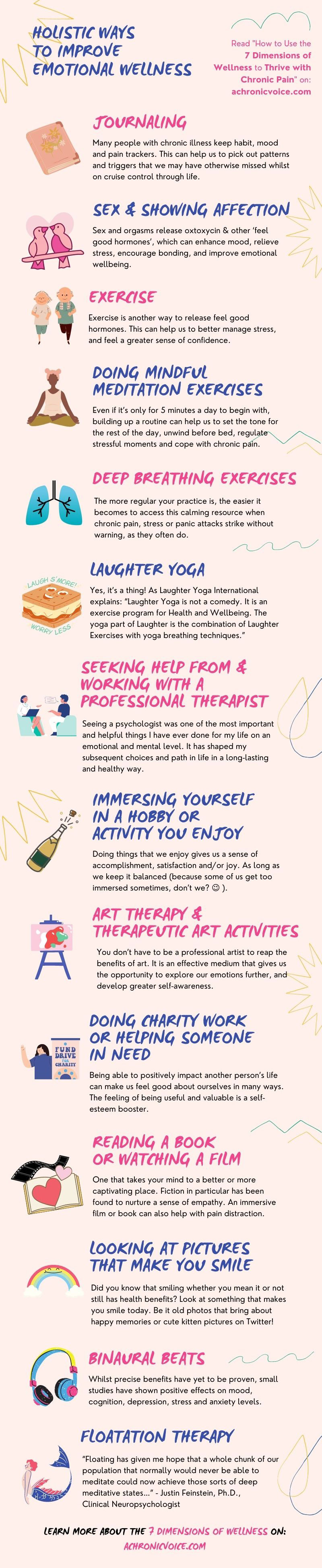
- **Journaling**
The benefits of journaling are widely known. What's best is that you can keep [all sorts of journals](https://www.psychologytoday.com/us/blog/here-there-and-everywhere/202001/discover-8-journaling-techniques-better-mental-health) for different purposes, too (Sarkis, 2020). Many people with chronic pain and chronic illness keep **[habit, mood and pain trackers](https://achronicvoice.com/uplifting-activities-to-do-while-recovering-in-bed/)** either by hand or using a digital app. This can help us to pick out patterns and triggers that we may have otherwise missed whilst on cruise control through life.
Some people do a 'thought dump' in their journals in the morning or right before bed. This is also known as [expressive writing](https://www.pathways.health/pain-awareness-through-journaling-and-using-it-to-manage-chronic-pain/), where you write without inhibition or care to punctuation, grammar or spelling (Chan, n.d.). Allowing thoughts to flow from your brain to your pen and paper can be a cathartic experience. It can help to sort your thoughts and feelings out, bring about insight, solutions and self-healing.
Read Related Posts:
- [Fun Things To Do While Recovering From Surgery: Hobbies, Crafts & Games](https://achronicvoice.com/fun-things-to-do-while-recovering-from-surgery/)
- [Knee Surgery for Spontaneous Bilateral Patellar Tendon Rupture: Weeks 1 – 6](https://achronicvoice.com/knee-surgery-spontaneous-bilateral-patellar-tedon-rupture-weeks-1-6/)
- [The Road to Recovery is the Longest of Them All](https://achronicvoice.com/road-to-recovery-longest/)
- [How to Prepare for a Medical Appointment in a Post-Pandemic World (4 Top Tips From a Doctor)](https://achronicvoice.com/prepare-medical-appointment/)
- [The Value in Seeking Out Moments of Gratitude (and How to do it)](https://achronicvoice.com/value-gratitude/)
- **Sex & Showing Affection**
[Sex and orgasms release oxtoxycin](https://www.healthline.com/health/love-hormone), also known as the 'love hormone' (Santos-Longhurst, 2023). Along with oxytocin are serotonin and dopamine, which are known collectively as the 'feel good hormones'. These hormones in return can enhance mood, relieve stress, encourage bonding, and improve our over all emotional wellbeing.
Read Related Posts:
- [Disability & Sex: Disabled People are Not Automatically Bad Sexual or Romantic Partners](https://achronicvoice.com/disability-and-sex/)
- [Dating with Chronic Illness (and What I’ve Learned)](https://achronicvoice.com/dating-with-chronic-illness/)
- [How to Set Healthy Boundaries in Your Relationships with Chronic Illness](https://achronicvoice.com/healthy-boundaries-relationships-chronic-illness/)
- **Exercise**
Exercise is another way to release feel good hormones. This can help us to better manage stress, and feel a greater sense of confidence and emotional wellbeing. According to Domonell (2016) on CNN Health:
> "[Endorphins](https://edition.cnn.com/2016/01/13/health/endorphins-exercise-cause-happiness/index.html), which are structurally similar to the drug morphine, are considered natural painkillers because they activate opioid receptors in the brain that help minimize discomfort... They can also help bring about feelings of euphoria and general well-being." - J. Kip Matthews, Ph.D, a sport and exercise psychologist
- **Doing Mindful Meditation Exercises**
Studies have shown that meditation changes the brain in profound ways. In fact, certain [areas of the brain that regulate emotions](https://www.ncbi.nlm.nih.gov/pmc/articles/PMC5337506/) have been found to be bigger in monks who as you know, meditate a lot (Guendelman et al., 2017). Even if it's only for 5 minutes a day to begin with, building up a positive habit such as a meditation routine has many benefits. It can help us to set the tone for the rest of the day, unwind before bed, regulate stressful moments and cope with chronic pain.
- **Deep Breathing Exercises**
The power and art of breathing are becoming 'lost' in our modern, busy lives. It's almost ironic we're often so stressed and tensed up that our breaths are shallow without us even noticing. Daily, focused deep breathing exercises were actually something both my psychologist and psychiatrist highly recommended to help manage my stress, anxiety and panic attacks. The more regular your practice is, the easier it becomes to access this calming resource when chronic pain, stress or panic attacks strike without warning, as they often do.
- **Laughter Yoga**
Yes, it's a thing! As [Kataria of Laughter Yoga International](https://laughteryoga.org/) (n.d.) explains:
> "Laughter Yoga is not a comedy. It is an exercise program for Health and Wellbeing. The yoga part of Laughter is the combination of Laughter Exercises with yoga breathing techniques ( Pranayama )."
[Glantz (2019) on NBC News also tried laughter yoga](https://www.nbcnews.com/better/lifestyle/i-tried-laughing-yoga-what-i-learned-about-myself-surprised-ncna1019436) and says, "*The takeaway: my inner child needs to come out and play*".
- **Seeking Help From and Working with a Professional Therapist**
I went through a year of [Inner Child Psychotherapy](https://psychotherapy.psychiatryonline.org/doi/full/10.1176/appi.psychotherapy.20180008) myself, although I didn't know that that was what it's called back then (Hestbech, 2018), only that I enjoyed that style of therapy for the depth of personal insight, and that it was working. I can say that seeing a psychologist was one of the most important and helpful things I have ever done for my life on an emotional and mental level. And that it has shaped my subsequent choices and path in life in a long-lasting and healthy way.
Read My Post on SubStack:
- [My Inner Child and the Angry Girl (Part II)](https://achronicvoice.substack.com/p/my-inner-child-and-the-angry-girl)
- **Immersing Yourself in a Hobby or Activity You Enjoy**
This probably goes without saying, but doing things that we enjoy gives us a sense of accomplishment, satisfaction and/or joy. As long as we keep it balanced with the rest of the dimensions of wellness (because some of us get too immersed sometimes, don't we? ;) )
- **Art Therapy & Therapeutic Art Activities**
[Art therapy has officially been around since the 1940s](https://www.canr.msu.edu/news/the%5Fbenefits%5Fart%5Ftherapy%5Fcan%5Fhave%5Fon%5Fmental%5Fand%5Fphysical%5Fhealth), and has proven to be [therapeutic and healing for many patients](https://www.ncbi.nlm.nih.gov/pmc/articles/PMC2804629/) with chronic pain and mental health issues (Stuckey & Nobel, 2010; Tiret, 2023).
The definition, as per the [American Art Therapy Association](https://arttherapy.org/about-art-therapy/) (n.d.):
> "Art therapy, facilitated by a professional art therapist, effectively supports personal and relational treatment goals as well as community concerns."
You don't have to be a professional artist to reap the benefits of art. It is an effective medium that gives us the opportunity to explore our emotions further, and develop greater self-awareness. Art isn't limited to the classic forms of painting or drawing either. You could also try your hand at floral arrangement, photography, craft work, sculpting, decorating, dancing, music (like my mum who picked up the ukulele at 60, and enjoys it to no end!), theatre, and so much more.
These days colouring books for stress relief are very popular. It is, after all, a way to be mindful as you’re focussed on the present moment. They also derive a sense of satisfaction when they’ve completed colouring a page. For those with arthritis or chronic pain in their hands or fingers, paint-by-numbers is also a popular way to do something similar. Paint brushes are lighter and easier to grip and control, as compared to colouring pencils. (**[Read this post to learn more and view visual samples of these arts and crafts](https://achronicvoice.com/fun-things-to-do-while-recovering-from-surgery/)**.)
- **Doing Charity Work or Helping Someone in Need**
Whether done with altruistic intentions or otherwise, being able to positively impact another person's life can make us [feel good about ourselves in many ways](https://www.helpguide.org/articles/healthy-living/volunteering-and-its-surprising-benefits.htm) (Segal & Robinson, 2018). The feeling of being useful and valuable is a self-esteem booster. You can also check out this series, ['Effective Altruism' on the 80,000 Hours podcast](https://80000hours.org/podcast/effective-altruism-an-introduction/) (n.d.), which uses evidence and analysis to find out how and where you can do as much good as possible.
If you live with chronic pain and chronic illness, there are still ways to volunteer thanks to the internet. You may not even have to get out of bed to make a positive difference in someone else's life. There are many non-profit organisations for example that need help with their social media, article writing, website set ups, administrative tasks and so much more.
For some inspiration and ideas, check out what [Lupus Chick](https://lupuschick.com/10-ways-to-help-others-while-dealing-with-chronic-illness/) (Zeppieri, 2018) and [Carrie of 'My Several Worlds'](https://www.myseveralworlds.com/2020/06/15/volunteer-work-when-you-are-chronically-ill/) (2020) have to share. They are both active advocates and volunteers in the community, despite being chronically ill themselves. You can also **[check out this post I wrote about how to be a health advocate from bed, especially when disabled or bed bound](https://achronicvoice.com/useful-things-to-do-while-on-bed-rest/)**.
If you do not have time, energy or the necessary expertise, [donating cash is actually one of the best ways to help a charity organisation](https://online.uga.edu/news/charitable-giving-volunteering-vs-donating/) out (Ridley & Zwald, 2021). Money is always needed for practical resources, and to reach out to those in need.
One of my favourite sites is [kiva.org](https://www.kiva.org/) (n.d.). I received a card that contained $25 once for a birthday present. I could then use it to choose whom I wanted to fund in their database online. These people would repay it slowly over time, and then you can use the money to fund someone else again. There are people who need all sorts of things from medical expenses either for themselves or loved ones, to buying food, obtaining cattle, repairing their houses, setting up a small business and more.
Pin to Your Chronic Illness, Disability & Humanity Boards:
- **Reading a Book, Or Watching a Film that Takes Your Mind to a Better or More Captivating Place**
Books and films of different genres can all be interesting. But [fiction in particular has been found to nurture a sense of empathy](https://www.researchgate.net/publication/269874783%5FThe%5FArt%5Fin%5FFiction%5FFrom%5FIndirect%5FCommunication%5Fto%5FChanges%5Fof%5Fthe%5FSelf) (Djikic & Oatley, 2014). As we move along the story with the protagonist and characters, we form connections and invest emotions into them. We put ourselves in their shoes. This can help us to see things from a different perspective; it can also make us feel heard and less alone if their situation is relatable. An immersive film or book can also help to distract you from chronic pain, if the pain levels are not overwhelming.
Read Related Posts:
- [Book Recommendations for Spoonies (but You’re All Invited, Too!)](https://achronicvoice.com/book-recommendations-spoonies/)
- [Book Recommendations for Spoonies: Part II](https://achronicvoice.com/book-recommendations-spoonies-2/)
- [Book Recommendations for the Chronically Ill: Part III](https://achronicvoice.com/book-recommendations-3-chronically-ill/)
- [Book Review: The Narwhal Who Suffers from Chronic Migraines](https://achronicvoice.com/book-review-narwhal-migraines/)
- [Magazine Review: Lucky Peach’s Last Issue, Ever](https://achronicvoice.com/magazine-review-lucky-peach/)
- **Looking at Pictures That Make You Smile**
Look at something that makes you smile today. Be it old photos that bring about happy memories, cute kitten pictures on Twitter, or just scrolling through funny pictures on your phone. Did you know that [smiling whether you mean it or not still has health benefits](https://www.nbcnews.com/better/health/smiling-can-trick-your-brain-happiness-boost-your-health-ncna822591) (Spector, 2018)? My friend, [Katie of 'Painfully Living' (2020), has a whole blog post written about this](https://painfullyliving.com/2020/10/24/smile-power-emotional-and-physical-healing/). The science behind it is fascinating, so have a read, and keep smiling!
- **Binaural Beats**
Binaural beats is a form of sound therapy where you listen to sounds of two different frequencies in each ear. Whilst precise benefits have yet to be proven, small studies have shown positive effects on mood. Participants have shown improvements in cognition, depression, stress and anxiety levels.
What's also interesting is that apparently, different sound frequencies can affect your brain in different ways. Thus the binaural beats that you select should be a [state of mind that you want to work towards](https://www.healthline.com/health-news/your-brain-on-binaural-beats), be it for deep relaxation, creativity, focussed attention or something else (Booth, 2019).
Do note that people with epilepsy and some other disorders might want to avoid trying binaural beats, as it may trigger instead of help their condition.
- **Flotation Therapy**
**[I was curious and first tried floatation therapy](https://achronicvoice.com/floatation-therapy-chronic-pain/)** for joint and muscle aches, as there were claims that they were great for chronic pain. I was disappointed in that regard, although there are studies that have shown [positive effects for stress-related pain](https://pubmed.ncbi.nlm.nih.gov/16341307/) (Bood et al., 2005).
An unintended side effect however, was the calmness that washed over me after I emerged. I felt almost high. The deep relaxation enabled me to have the best sleep I have had in literally years that night. Fascinated, I went to read up more about it. Not everyone is great at meditation (like me), but I discovered that floatation therapy is one of the few ways that any human being can use to enter a meditative state of mind.
> [“Floating has given me hope that a whole chunk of our population that normally would never be able to meditate could now achieve those sorts of deep meditative states...”](https://time.com/floating/) Justin Feinstein, Ph.D., Clinical Neuropsychologist (TIME, n.d.)
Pin to Emotional Wellness & Infographic Boards:
## The Fourth Dimension of Wellness – Intellectual Wellness
Intellectual wellness is the pursuit of lifelong learning and self-improvement. It is about our engagement in mentally stimulating and creative activities. It is a chance to both expand your knowledge, and also to share your talents and skills with others. Intellectual wellness is sometimes equated with IQ or academic knowledge. But it goes beyond that to encompass common sense, critical thinking, general knowledge and creativity, too.
> “A mind that is stretched by a new experience can never go back to its old dimensions.” – Oliver Wendell Holmes, Jr.
Pin to Your Intellectual Wellness & Self-Improvement Boards:
### The Importance of Keeping Our Minds Sharp
Our mind is our greatest asset, so it is of critical importance to keep it sharp and stimulated. Like our bodies, it needs constant exercise and inspiration. Whilst the precise causes of dementia and Alzheimer’s disease are still unknown, some studies indicate that keeping our minds active in key ways may help stave them off. It is more than just stimulating our brains, but also to encourage it to keep learning new skills. To make it work in ways that it is unfamiliar with.
### The Benefits of Working on Your Intellectual Wellness
The benefits of working on your intellectual wellness are manifold. Apart from learning to be a critical thinker and the ability to view things from different perspectives, you will also gain a deeper understanding of who you are as a person, and what values you hold dear.
I personally believe that there is always a 'next level of life' that we can strive for in this regard. And that we will never know our full potential unless we unlock those doors and strive for it.
> *“Life is a process of becoming, a combination of states we have to go through. Where people fail is that they wish to elect a state and remain in it. This is a kind of death.” – Anaïs Nin*
> “The goal is not to change who you are but to become more of who you are at your best.” – Sally Hogshead
Pin to Your Personal Development & Motivational Quote Boards:
Read Related Posts:
- [Every Next Level of Your Life Will Demand a Different You](https://achronicvoice.com/next-level-life/)
- [Life is a Long Process of Becoming Into…](https://achronicvoice.com/life-is-a-long-process-of-becoming-into/)
- [The Secret of Change: Spend Your Energy Wisely with Chronic Illness](https://achronicvoice.com/secret-of-change/)
- [The Subtle Difference Between Saying “Think Positive” and “Stay Positive” to Someone with Chronic Pain](https://achronicvoice.com/difference-think-positive-stay-positive-chronic-pain/)
- [April 2019: Tiring First Quarter Being Muggle Sick](https://achronicvoice.com/tiring-first-quarter-muggle-sick-april-2019/)
### Some Ways to Work on Our Intellectual Wellness
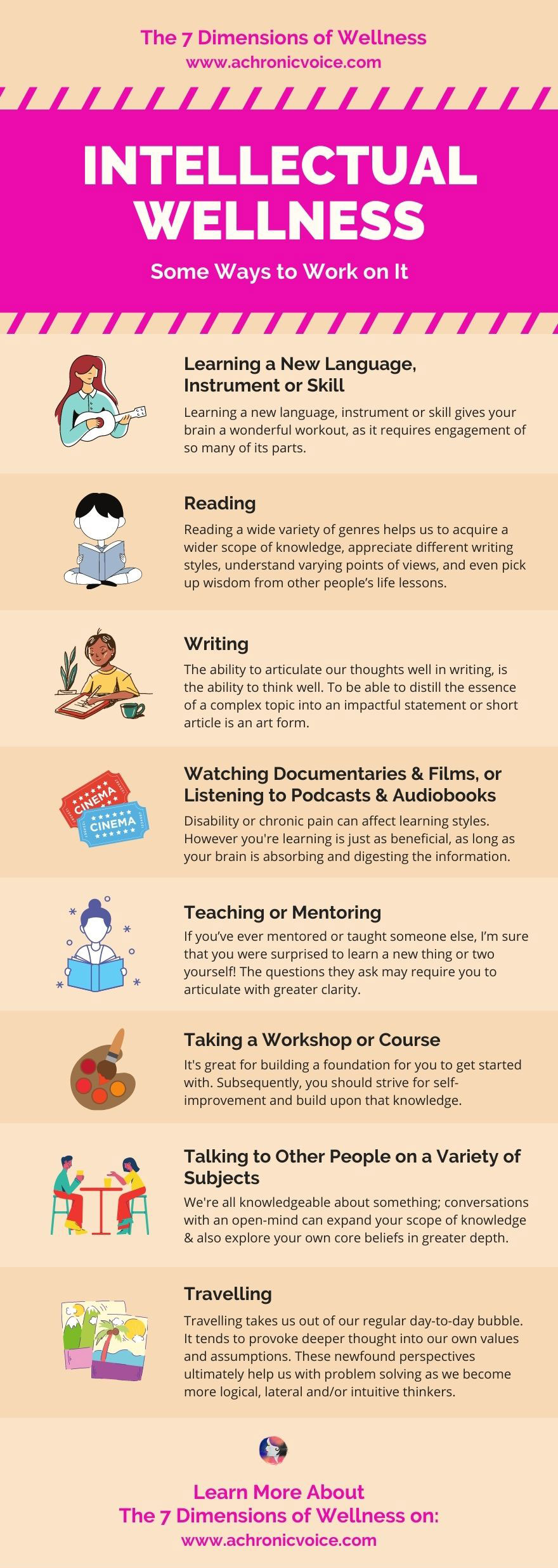
The key to improving intellectual wellness is to always be learning something foreign to you. It doesn’t matter if you’re good or bad at it. What’s important is to give your brain a good workout.
Here's a list of both easy and challenging things you can try to work on your intellectual wellness:
- **Learning a New Language, Instrument or Skill**
Learning a foreign language is hard. It goes beyond vocabulary and confusing grammar structures (or lack of one!). Languages encompass thousands of years of culture, emphasis on different values and life perspectives, logic and so much more. P.s. As a web developer, I also consider code as a language, a very logical one!
Learning a new instrument also gives your brain a wonderful workout, as it requires engagement of so many of its parts. You need coordination, and the ability to integrate and apply sensitivity to basic sensory skills. There are even studies that show that [musicians have different brain structures](https://www.inc.com/john-rampton/the-benefits-of-playing-music-help-your-brain-more.html) from non-musicians; their corpus callosum is larger, which is a bunch of nerve fibres that connect the two sides of the brain (Rampton, 2017).
Regardless of whatever new skill you're intending to pick up, it is a good idea to work with a mentor if that's an option. A [good mentor has the ability to guide you properly](https://www.ncbi.nlm.nih.gov/books/NBK552775/) and encourage you to improve (National Academies of Sciences, Engineering, and Medicine, 2019). Otherwise, you might end up feeling frustrated and give up, rather than stimulated. (**[Read this post for free education resources and ideas](https://achronicvoice.com/useful-things-to-do-while-on-bed-rest/)**.)
- **Reading**
We've covered reading before for other dimensions of wellness, but its benefits are numerous. It's important to [diversify and read a wide variety of genres](https://nybookeditors.com/2018/10/the-importance-of-reading-other-genres) in application to intellectual wellness (NY Book Editors, n.d.). Not only do we acquire a wider scope of knowledge, we also learn to appreciate different writing styles, learn new vocabulary, understand varying points of views, and even pick up wisdom from other people's life lessons.
- **Writing**
Writing is a personal one for me. It's a passion, and I believe that the ability to [articulate our thoughts well in writing](https://www.inc.com/peter-economy/5-remarkably-powerful-hacks-to-become-more-articulate-you-dont-have-to-give-a-ted-talk-to-do-it.html), is the ability to think well (Economy, 2019). To be able to [distill the essence of a complex topic](https://hbr.org/1973/01/clear-writing-means-clear-thinking-means) into an impactful statement or short article is an art form (Swift, 1973). P.s. Once again, writing code is also writing!
In fact, I often get hungry after concentrating hard on writing or coding. Curious, I learned that thinking does burn calories, though of course, not as much as exercise does. From TIME magazine (Heid, 2018):
> “The bulk of your brain’s energy consumption is put toward sustaining your alertness, monitoring your environment for important information, and managing other “intrinsic” activities. In terms of its energy demands, “an [individual thought is cheap, but the machinery that makes it cheap is very expensive](https://time.com/5400025/does-thinking-burn-calories/).” - Dr. Marcus Raichle, a distinguished professor of medicine at Washington University School of Medicine in St. Louis
> “Writing is thinking. To write well is to think clearly. That’s why it’s so hard.” ― David McCullough
Pin to Your Writing, Reading & Intellectual Wellness Boards:
- **Watching Documentaries & Films, or Listening to Podcasts & Audiobooks**
Many people do not enjoy reading, but prefer to listen to an audiobook or podcast, or watch a film. This may be due to a disability or chronic pain which can affect learning styles. Whatever the reason, doing so is just as beneficial as long as you are paying attention and your brain is absorbing and digesting the information. (**[Check this post out for audiobook, podcast and film resources](https://achronicvoice.com/things-to-do-on-digital-devices-after-knee-surgery/)**).
Documentaries, films and animations are a great way to expand our knowledge and stimulate creativity too, as the visual elements help to show us something that our brains might not even be able to conjure in the first place.
- **Teaching or Mentoring**
**[If you’ve ever mentored or taught someone else](https://achronicvoice.com/roy-george-dramatic-life-short-bowel/)**, I’m sure that you were surprised to learn a new thing or two yourself! The questions your student or mentee ask may be something that have never crossed your mind. Or perhaps you’ve had to understand the topic even deeper in order to articulate it with more clarity.
- **Taking a Workshop or Course**
Always wanted to **[learn how to bake, code, blog or do a fabulous flower arrangement](https://achronicvoice.com/fun-things-to-do-while-recovering-from-surgery/)**? Perhaps now is a good time to do so! A workshop or course is great for building a foundation for you to get started with. Subsequently, you should strive for self-improvement and build upon that knowledge.
- **Talking to Other People on a Variety of Subjects**
Conversations and debates done with an open-mind can be a very interesting way to learn new things. We’re all knowledgeable about something, so there’s always something we can learn from others. It’s also a great opportunity to **[force our brains to consider different viewpoints](https://achronicvoice.com/keeping-up-despite-pain/)**, understand them, and also to explore our own core values and beliefs.
- **Travelling**
**[Travelling takes us out of our regular day-to-day bubble](https://achronicvoice.com/travelling-with-chronic-illness-disability/)**, which can be both frightening and exhilarating. But it tends to always provoke deeper thought into our own values and assumptions. Things we've always taken for granted, or accepted without question. It pushes the boundaries of the mind, and expands it.
These newfound perspectives ultimately help us with problem solving as we become more logical, lateral and/or intuitive thinkers. To learn more, I highly recommend this book by Richard Conrad, “[Culture Hacks: Deciphering Differences in American, Chinese, and Japanese Thinking](https://www.amazon.com/dp/1544503148?&linkCode=ll1&tag=achronicvoice-20&linkId=b571f81d49e426feaa0f6d09d282bd48&language=en%5FUS&ref%5F=as%5Fli%5Fss%5Ftl)”.
Pin to Your Intellectual Wellness & Infographics Boards:
## The Fifth Dimension of Wellness – Social Wellness
According to Martino et al. (2015):
> ["Social connection is a pillar of lifestyle medicine](https://www.ncbi.nlm.nih.gov/pmc/articles/PMC6125010/). Humans are wired to connect, and this connection affects our health."
No human being can survive alone. We are interdependent beings who [need to feel like we belong](https://www.tandfonline.com/doi/abs/10.1080/19349637.2014.864541) somewhere (Shevellar et al., 2014). A lack of it – as has been [clearly demonstrated during this COVID19 pandemic](https://link.springer.com/article/10.1186/s40359-023-01130-5) – leads to isolation, depression, and other physical and mental health problems (Kupcova et al., 2023). In fact, captors use [social isolation as a means to torture prisoners](https://www.ncbi.nlm.nih.gov/pmc/articles/PMC3150158/) of war (Umberson & Montez, 2010). It is that powerful.
[Social interactions can influence our wellbeing and biology](https://newsinhealth.nih.gov/2017/02/do-social-ties-affect-our-health) (National Institutes of Health \[NIH\], 2017). Whilst it may be a little harder to interact in-person with the ongoing pandemic, the effort to stay connected, and the quality of interactions still play a big role in our social wellness.
Social wellness emphasises the community aspect of our humanity and environment. We all have different strengths and weaknesses, which we can give and receive. Being self-aware and knowing our core values by working on the other dimensions of wellness, in particular on our emotional and spiritual wellness, has a direct impact in this regard.
Read Related Posts:
- [29 Best Tips on How to Cope with Isolation at Home (from People Who Have Done and Will Do This All Their Lives)](https://achronicvoice.com/cope-with-isolation/)
- [33 Things That Stop People with Chronic Illness From Leaving the House (Sans COVID-19)](https://achronicvoice.com/things-stop-people-chronic-illness-leaving-house/)
- [COVID-19 Vaccine Experiences from People with Chronic Conditions](https://achronicvoice.com/covid-19-vaccine-experiences/)
- [7 Ways to Be a Better Friend to Someone with a Chronic Illness (and 3 Things You Should Never Do)](https://achronicvoice.com/better-friend-chronic-illness/)
- [Keeping Up with the World: Why it’s Important Despite Pain](https://achronicvoice.com/keeping-up-despite-pain/)
Pin to Your Social Wellness & Humanity Boards:
### Sometimes It Means Saying ‘No’, and The Need to Diverge
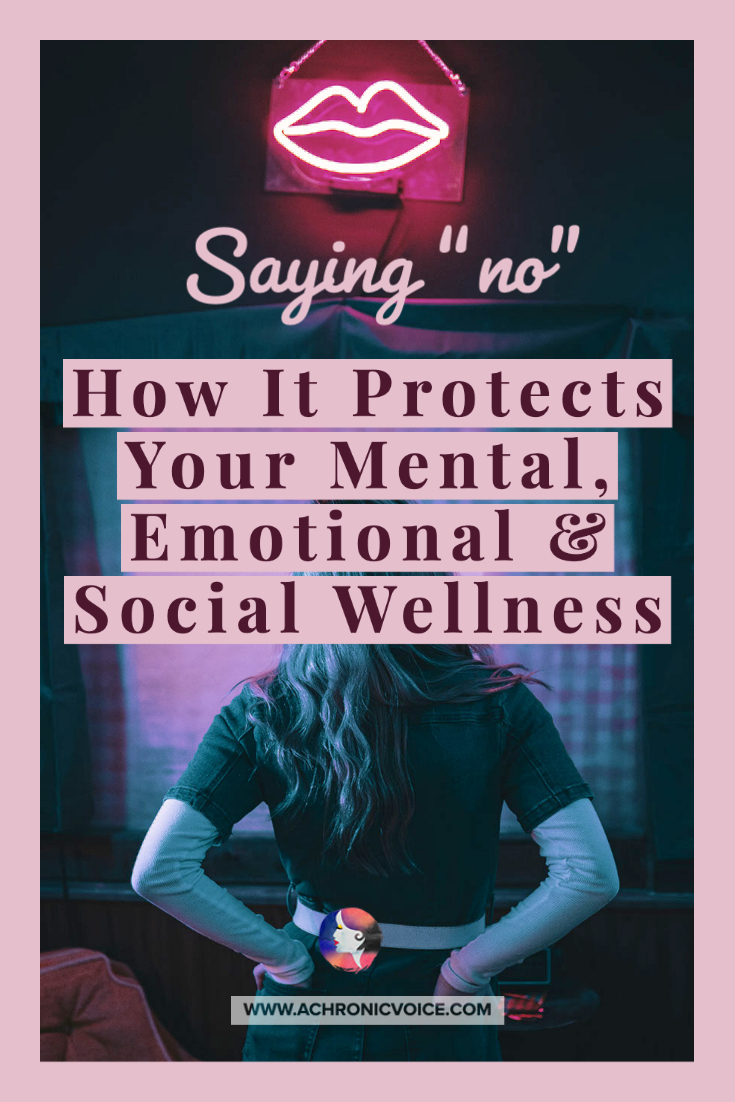
Being social also doesn’t mean that you need to constantly expand your network; the [quality of those relationships matter most](https://news.syr.edu/blog/2020/04/22/why-relationships-matter-maybe-now-more-than-ever/) (Plummer, 2020). Sometimes to maintain social wellness means [**saying ‘no’ to toxic relationships**](https://www.achronicvoice.com/2022/01/25/healthy-boundaries/).
Another thing to be aware of is that [we all change over time as human beings](https://www.theatlantic.com/health/archive/2015/10/how-friendships-change-over-time-in-adulthood/411466/) (Beck, 2015). It is okay and a natural part of life to drift apart and go down different paths. But it is equally as vital to replenish those human interactions as well, no matter your age or status. This might be harder as we grow older, but not impossible. I see plenty of articles along the lines of “[how to make friends as an adult](https://www.theguardian.com/lifeandstyle/2018/apr/30/how-to-make-new-friends-adult-lonely-leap-of-faith)” on the internet (Sedghi, 2018). Those articles were probably written because there are many others out there like you, who are looking for new, meaningful friendships.
Pin to Your Social Wellness & Self-Care Boards:
### Some of the Benefits & Signs of Social Wellness
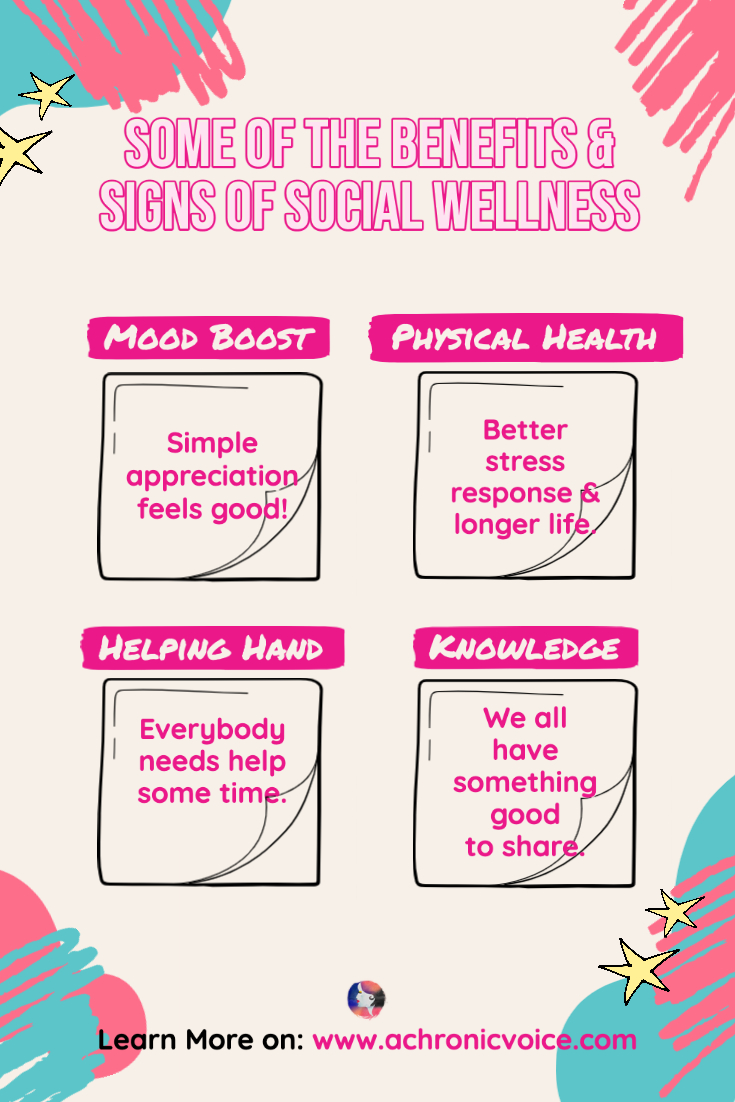
This network of [social support comes with massive benefits](https://www.ncbi.nlm.nih.gov/pmc/articles/PMC2921311/) that spills over to the other dimensions of wellness (Ozbay et al., 2007). Kind of sticky like glue. Have a look:
- **A Positive Impact on Our Emotional Wellness**
Doesn’t it invoke those warm, fuzzy feelings when someone appreciates you, or simply had you in their thoughts? So simple, yet can mean so much!
- **Physical Wellness Benefits**
Studies have found that people with strong social networks and healthy relationships tend to live longer, and respond better to stress.
- **Tangible Aid**
Sometimes we need an actual, physical helping hand. For example, those who are suffering with chronic pain or a disability **[might need to go to the Emergency Department](https://achronicvoice.com/refused-treatment-hospital/)**, but can't drive. Or they might **[need help with preparing a nutritious meal, or tidying the house](https://achronicvoice.com/dangerous-gifts-chronic-illness/)**. **[Even healthy people need support at times](https://achronicvoice.com/asking-for-help-life-skill/)**, such as with babysitting, running errands, or tapping into someone else's knowledge.
- **Sharing Our Wealth of Information & Knowledge**
We all possess different skills and knowledge. We all know something well, even if it's how to **[operate the entire hospital bed](https://achronicvoice.com/must-haves-after-knee-surgery/)** to precision. Being able to tap into the brains of others can save us a lot of time as we gain information with speed and precision. Being able to share your knowledge is a natural self-esteem booster and makes you feel valued as well.
In terms of chronic illness, disability and patient care, I truly hope that more healthcare organisations will come to realise this (Tabrizi & Morgan, 2014):
> “Healthcare organisations have recently realised that [medical knowledge not only needs to be managed but also shared among professionals and patients](http://www.ijmar.org/v1n2/14-004.html). Inadequate knowledge sharing in healthcare organisations can lead to medical errors. As a result, knowledge sharing in healthcare industry may no longer be a “nice to have” process but changes into a “must have” one.”
Pin to Your Social Wellness & Healthcare Boards:
### What if Chronic Pain or Disability Limits Your Ability to be More Social?
Not everyone who lives with chronic pain or a disability has family or friends to depend on, which can be a very scary thought. And even if they do, tension can run high at home. The added financial, mental, emotional and social impact can [take a toll on each family member’s quality of life](https://www.ncbi.nlm.nih.gov/pmc/articles/PMC3791092/) (Golics et al., 2013).
Chronic pain or disability in itself can make it harder to leave the house and to meet people. Even Zoom chats can be exhausting. As a result, we need to find novel ways to take care of our social wellness. Whilst social media can be a vice, it can also be a positive tool for those with chronic illnesses to improve their social wellness.
I’ve personally made many good friends who are also chronically ill online, whom I speak to on a daily basis. No one else but they would understand (or become bored) with the babble about chronic pain and mental health issues day in and out. This makes me feel less alone and improves my morale, as we encourage and help each other to rationalise, and to make decisions for the betterment of our wellbeing.
Read Related Posts:
- [The Savagery of Panic Attacks & The Saving Grace of Internet Friends](https://achronicvoice.com/panic-attacks-internet-friends/)
- [What’s it Like to be the Mother of a Sick Child? (Precious Insights from My Own Mum)](https://achronicvoice.com/mother-of-chronically-ill-child/)
- [What’s it Like to be the Father of a Child with Chronic Illness? (Precious Insights from My Own Dad!)](https://achronicvoice.com/father-of-child-with-chronic-illness/)
- [4 Cool Truths My Partner Said (Unwittingly)](https://achronicvoice.com/cool-truths/)
- [We Want to Have Fun Just Like You, But Here’s What it Takes](https://achronicvoice.com/want-to-have-fun-chronic-illness/)
Pin to Your Chronic Illness, Disability & Social Wellness Boards:
### Holistic Ways to Improve Social Wellness
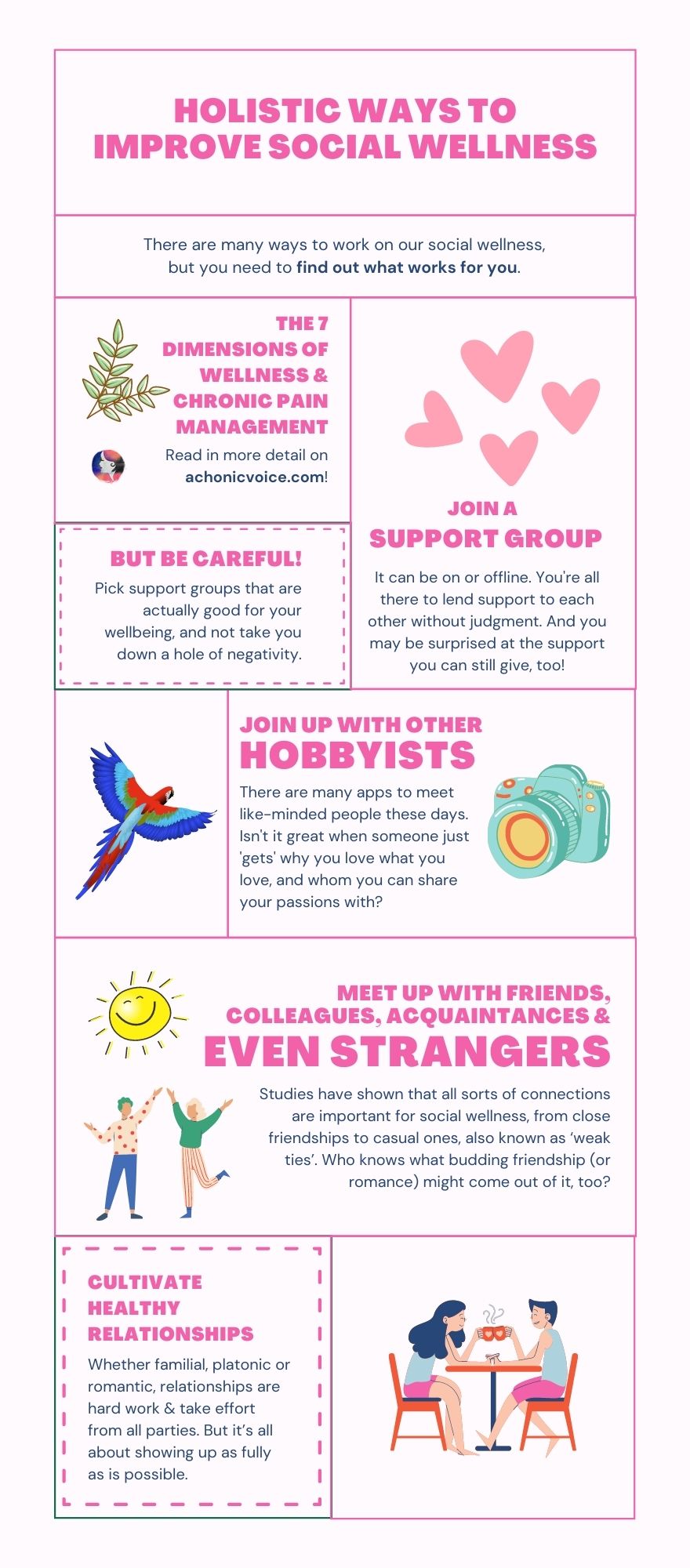
There are many ways to improve our social wellness, but it is also highly dependant on your personality type, what and where you draw energy from. Going to the bar for a chat and drinks may energise one person, but wipe someone else out for two weeks. Find what works for **you**. Here are a few suggestions:
- **Joining a Support Group Online or Offline**
Are you a parent who’s struggling to juggle kids and chronic pain? Or maybe you’re trying to quit a bad habit? Or perhaps you live with a disability or chronic pain, and struggle with everyday life.
Joining a support group can be helpful, as you’re all there to lend support to each other without judgment. I’ve also heard of people going to support groups, and being pleasantly surprised to find out that they still had something valuable to contribute to others.
There are also many support groups that you can join online. Some can be rather specific, such as for certain chronic illnesses. Just be careful to pick the ones that are actually good for your social and emotional wellbeing. And not ones that take you down a dark hole of negativity.
- **Join Up with Other Hobby Enthusiasts**
Perhaps you have a huge love for bird watching, knitting or playing tennis. These days there are many apps and online forums to connect with new people who share the same passions as you do. It’s also wonderful to meet others who ‘get’ why you love your hobby. You can bounce ideas off each other, collaborate, share tips and tricks to hone your skills and fuel your passion. This certainly adds to satisfaction in life!
- **Meeting up with Friends, Colleagues, Acquaintances & Even Strangers**
Studies have shown that all sorts of connections are important for social wellness, from close friendships to casual ones, also known as “[weak ties](https://www.bbc.com/worklife/article/20200701-why-your-weak-tie-friendships-may-mean-more-than-you-think)” (Leslie, 2020).
Earlier on I did say to stay away from toxic friendships and to nourish the quality ones. In this instance, the idea is to get to know a wide variety of people better. Who knows what budding friendship (or romance) might come out of it? If it's impossible to meet up, a video call or chatting on the phone can also be beneficial. If energy is limited, planning your day - or even week or month - to make time for such activities can be helpful.
- **Cultivating Healthy Relationships, Whether Familial, Platonic or Romantic**
Relationships are hard work; they take persistent effort from all parties. You need to keep in touch, and express appreciation in your own ways. Yet the things that you do together do not have to be complicated. It’s all about showing up as fully as is possible.
You could do a dinner date right at home, or play board games together. Little moments like these often become wonderful lifelong memories that we treasure. You could bake cookies for your friends and family, buy or make them a nice gift, or even just lend your ear and listen to them without judgment.
In fact, that is actually one of the best things you can do for a person who’s suffering from chronic pain. They are often not looking for advice; they’ve probably tried them all. But they want to express how they feel and get a load off their chest.
For More Insight, Read:
- [Dating with Chronic Illness (and What I’ve Learned)](https://achronicvoice.com/dating-with-chronic-illness/)
- [7 Ways to Be a Better Friend to Someone with a Chronic Illness (and 3 Things You Should Never Do)](https://achronicvoice.com/better-friend-chronic-illness/)
- [September 2018: Reconnecting with Friends & Family, and Sharing on Social Media](https://achronicvoice.com/reconnecting-friends-family-sharing-social-media-september-2018/)
- [Dangerous Gifts for People with Chronic Illnesses (and Gift Ideas to Swap Them With)](https://achronicvoice.com/dangerous-gifts-chronic-illness/)
- [Curated Chronic Illness Gift Ideas for Christmas, Birthdays & Other Occasions!](https://achronicvoice.com/chronic-illness-gift-ideas/)
- **Contributing to Society**
You could donate blood or volunteer for a charitable organisation. You could also **[advocate for a cause through blogging](https://achronicvoice.com/useful-things-to-do-while-on-bed-rest/)**, participating in awareness events, or even by resharing useful stories and articles to your social media (just **[be very careful not to spread misinformation](https://achronicvoice.com/what-you-reshare-can-change-life/)**!). Such contributions not only help to better society and humanity as a whole, but will also enable you to feel good and useful as a human being.
> “Think of giving not as a duty but as a privilege.” - John D. Rockefeller, Jr.
> “If you think you are too small to make a difference, try sleeping with a mosquito.” — Dalai Lama
> “How wonderful it is that nobody need wait a single moment before starting to improve the world.” — Anne Frank
Pin to Your Social Wellness & Infographic Boards:
## **The Sixth Dimension of Wellness – Spiritual Wellness**
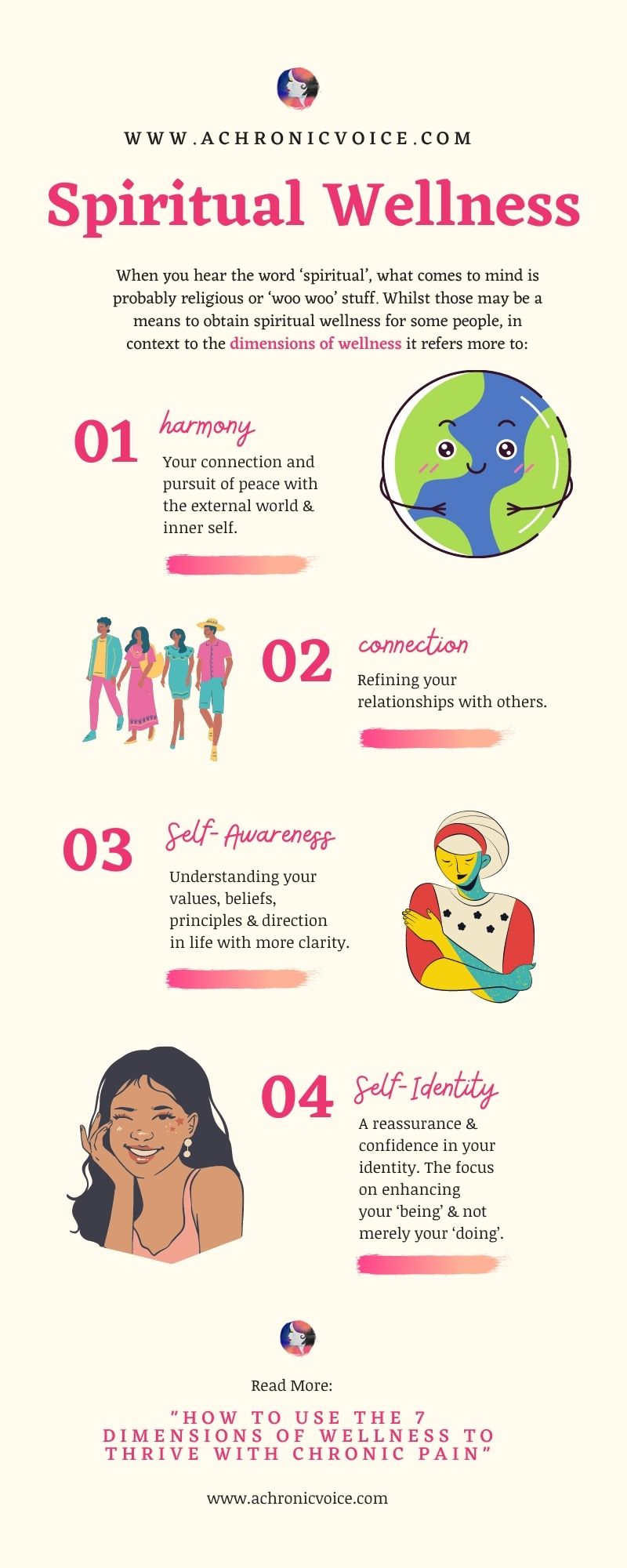
When you hear the word ‘spiritual’, what comes to mind is probably religious or ‘woo woo’ stuff. Whilst those may be a means to obtain spiritual wellness for some people, [in context to the dimensions of wellness](https://pmc.ncbi.nlm.nih.gov/articles/PMC5508938/) it refers more to (Stoewen, 2017; [University of New Hampshire, 2020](https://www.unh.edu/health/spiritual-wellness)):
- Your connection and pursuit of peace with the external world and inner self.
- Refining your relationships with others.
- Self-awareness; Understanding your values, beliefs, principles and direction in life with more clarity.
- Reassurance in your self-identity; The focus on enhancing your ‘being’ and not merely your ‘doing’.
Put in simple terms, spiritual wellness aims to bring about harmony both within and without through self-knowledge, acceptance and flow. It is a lifelong pursuit that requires constant refinement and adaptation. It fluctuates in conjunction with our emotions, life experiences, circumstances and world events around us.
> “It is not the strongest of the species that survive, nor the most intelligent, but the one most responsive to change.” — Charles Darwin
> “Out of clutter, find simplicity. From discord, find harmony. In the middle of difficulty lies opportunity.” — Albert Einstein
Pin to Your Spiritual Wellness & Infographics Boards:
### The Benefits of Spiritual Wellness
**Resilience**
We develop the ability to weather the storms in our life with more resilience and grace, because we know what we stand for, and what matters to us. We are aware of our capabilities and potential as an individual. [Resilience is an important trait in stress and anxiety management](https://www.apa.org/topics/resilience) (American Psychological Association, n.d.), and critical when dealing with chronic pain with no end date in sight.
> “Maybe life isn’t about avoiding the bruises. Maybe it’s about collecting the scars to prove that we showed up for it.” — Hannah Brencher
Read Related Posts:
- [I May be Chronically Ill, but I’m Also Chronically Resilient](https://achronicvoice.com/chronically-ill-resilient/)
- [7 Proven Strategies to Stay Resilient No Matter What Happens (from A to G)](https://achronicvoice.com/strategies-stay-resilient/)
- [Kick Ass With Kindness and a Sweet Cherry on Top](https://achronicvoice.com/kick-ass-with-kindness/)
- [Call Me Sick Girl (Or How to Make Your Weakness Your Strength)](https://achronicvoice.com/sick-girl-make-weakness-strength/)
- [Why Self-Acceptance is Important When You Have a Chronic Illness](https://achronicvoice.com/self-acceptance-chronic-illness/)
- **Acceptance**
Contrary to popular belief, acceptance is **not** a sign of defeat or weakness, and certainly does not mean a person is giving up. I know this full well from my own decade long rebellion against acceptance of my chronic illnesses. I swore at 14 that I’d ‘fight them to the death’. [Only to realise after 10 years with the help of a wonderful psychologist](https://achronicvoice.substack.com/p/my-inner-child-and-the-angry-girl), that I could only bash myself against the wall for so long.
Chronic illness isn’t my or my body’s fault. The battles I fight are pointless, because there are no winners when it’s my own body whom I’m pitting myself against. Acceptance lifts the self-guilt, self-blame and hatred, so that you can start advocating and caring for yourself and those around you. Loving your body, nourishing it and working with it can only bring better results.
It brings about freedom. The freedom to channel that energy, anger and fire into something more useful and beautiful. It means to be at peace with ‘what is’ and not to be plagued by all the ‘what ifs’, which are highly deceptive and torturous. Acceptance is powerful. It unlocks the floodgates of your potential, when you realise that there is so much more you **can do and give** from where you stand (or sit, or lie). Here are [14 benefits of practising acceptance](https://psychcentral.com/blog/cultivating-contentment/2018/08/14-benefits-of-practicing-acceptance) that are spot on (Woods, 2018).
> “The secret of change is to focus all of your energy not on fighting the old, but on building the new.” – Socrates
- **A Sense of Empowerment**
Exploring and understanding your inner self can be an inspiring process, with you as the source of your own inspiration. This can lead to a sense of empowerment in the knowledge that you’ve got your own back. That even though your circumstances are stressful or challenging, they are not a definition of who you are as a person. That you still hold value with no strings attached. And that you still have the ability to contribute in one way or another.
> “People can be at their most vulnerable, but still tenacious at the same time.” — Toni Bernhard
> “You can change the world again, instead of protecting yourself from it.” ― Julien Smith, The Flinch
Pin to Your Self-Worth & Inspirational Quote Boards:
Read Related Posts:
- [An Inspirational Poem on Miracles, by Thuli Zuma](https://achronicvoice.com/poem-on-miracles-thuli-zuma/)
- [Why Your Beauty Never Left You](https://achronicvoice.com/why-your-beauty-never-left-you/)
- [Flowers are the Most Beautiful When They’re Just About to Die (and What That’s Got to Do with Being a Spoonie)](https://achronicvoice.com/flowers-most-beautiful-die-spoonie/)
- [#projChronicWisdom: Secret Motivation Tips for When You’re Unmotivated](https://achronicvoice.com/projchronicwisdom-motivation-tips/)
- [February 2019: Hopes to Awaken Life Within Me Again](https://achronicvoice.com/february-2019-awaken-life-within-me/)
- **Self-Compassion**
Self-compassion is an extension of acceptance, where we **give ourselves the permission we need to heal**. It is to be aware of it and say, "I'm in too much pain to do much right now. I need to rest, and to take good care of my mind, body and spirit". And to be at peace with that.
It is to say, "I may not be great at this task or am not where I want to be in life, but that's okay. I give myself the permission to fail. But I will pick myself up when I'm ready, and become a better person in line with what I value in life".
> “Your task is not to seek for love, but merely to seek and find all the barriers within yourself that you have built against it.” – Rumi
> “Make your heart as vast as space, so big that nothing can harm it. When our hearts are that wide, it is as if the judgments are ripples on water, flowing away and leaving no trace. This is what vulnerability makes possible. It allows the natural strength of the heart to emerge.” - Mark Coleman, “[Make Peace with Your Mind: How Mindfulness and Compassion Can Free You from Your Inner Critic](https://www.amazon.com/dp/160868430X?&linkCode=ll1&tag=achronicvoice-20&linkId=73338320ec5312823c0ac6c27e5b5086&language=en%5FUS&ref%5F=as%5Fli%5Fss%5Ftl)”
Pin to Your Self-Compassion, Healing & Quote Boards:
Read Related Posts:
- [You Don’t Have to be Strong, Just a Little Stronger Than Before](https://achronicvoice.com/you-dont-have-to-be-strong/)
- [7 Reminders For Those Bad Days to Keep You Going](https://achronicvoice.com/reminders-for-bad-days/)
- [Life with Chronic Illness: Happiness & Pain Can Co-exist](https://achronicvoice.com/chronic-illness-happiness-and-pain/)
- [A String of Bad Days (and What Happened When That Good Day Finally Came Along)](https://achronicvoice.com/bad-days-good-day-finally-came/)
- [Don’t Compare, Your Life Destination is Your Own Special Mission](https://achronicvoice.com/dont-compare-life-destination-special/)
- **A Sense of Purpose in Life**
For many people, **[a purpose or goal in life](https://achronicvoice.com/life-purpose/)** can very powerful, and be their biggest motivation to keep going. When you live with chronic pain, this sense of purpose may be even more crucial as you live with more bad days than good.
Paying attention to our spiritual wellness can help us to realise and define the things that matter most to us in life, and to strive for them. This can lead to more immersive and fulfilling experiences that we create for ourselves despite circumstances.
**[Chronic illness or a disability may put up (some bloody huge) barriers](https://achronicvoice.com/bucket-list-chronic-illness/)**. But that doesn't mean that we cannot achieve our goals. We just need to go about it in a non-traditional way with a bit more inventiveness. Here are a few great quotes that sum it up:
> "Remember, don't try to build the greatest wall that's ever been built. Focus on laying a single, expertly-placed brick. Then keep doing that, every day." - Will Smith
> "Big things are built one brick at a time. Victories are achieved one choice at a time. A life well lived is chosen one day at a time." - Lysa TerKeurst
> "Architecture starts when you carefully put two bricks together. There it begins." - Ludwig Mies van der Rohe
> “Take the first step in faith. You don't have to see the whole staircase, just take the first step.” - Martin Luther King Jr.
Read Related Posts:
- [I Have No Purpose in Life, and Therein Lies My Life Purpose](https://achronicvoice.com/i-have-no-purpose-in-life/)
- [Man’s Search for Meaning by Viktor Frankl: 16 Takeaways with Chronic Illness](https://achronicvoice.com/mans-search-for-meaning-chronic-illness/)
- [Interview on ‘The Uninvisible Pod’: What I’ve Learned From Living with Chronic Illness for 20 Years](https://achronicvoice.com/interview-uninvisible-pod/)
- [A Car Accident & A Song Gone Silent (How Life Lessons from Chronic Illness Tide Me Through)](https://achronicvoice.com/chronic-illness-life-lessons-accident-bird/)
- [Call Me Sick Girl (Or How to Make Your Weakness Your Strength)](https://achronicvoice.com/sick-girl-make-weakness-strength/)
- **A Deeper Understanding of Your Core Values**
What do you value most in life, and why? Why do you want to pursue the things you do? Most of us can probably give a brief answer to these questions, but not always articulate them wholly or properly. These **[values fluctuate according to our personal growth and changes in life circumstances](https://achronicvoice.com/next-level-life/)**. This makes it even more necessary to keep in touch with our inner state of being and values. It is not a one-off event or definition.
> “Don’t push growth; remove the factors limiting growth.” – Peter Senge
> “Don’t go through life, grow through life.” – Eric Butterworth
- **Reassurance in Your Self-Identity**
When you are diagnosed with a chronic illness or disability, it's [hard not to question your self-identity](https://www.ncbi.nlm.nih.gov/pmc/articles/PMC3056146/) (Karnilowicz, 2011). Who are you without the career that was supposed to last you until retirement? What are you worth when your physical capabilities and productivity levels are non-existent? This **[deep sense of loss](https://achronicvoice.com/loss-of-identity-chronic-illness/)** can leave you feeling quite helpless and naked on the inside.
My spoonie friend, Shruti of 'All Things Endometriosis', articulates it so well [in this article](https://allthingsendometriosis.com/spoonie-chronic-illness-change-you/) (Chopra, 2021):
> "Being sick may have taken me away from fulfilling my potential the way I had dreamed of, but it has challenged me to rework that potential and grow. I love and respect the person I have become because of my challenges. I am grateful that I have been able to do that..... Some days I manage and some days I mourn the person I felt I could have been, which we’re all allowed to do because every emotion is valid."
When you work on your spiritual wellness, you start to realise the beauty of that nakedness deep within you. That that [vulnerability is actually a strength](https://medium.com/the-mission/how-to-embrace-vulnerability-as-your-greatest-strength-d2ac2b80ba52) that keeps you anchored (Fahkry, 2018). That you are whole as a person, even if you do not have the shiny shoes of productivity to slip into every day. It is one of the greatest opportunities you can get in life, to learn to truly love yourself for who you are.
> “To share your weakness is to make yourself vulnerable; to make yourself vulnerable is to show your strength.” — Criss Jami
> “We are at our most powerful the moment we no longer need to be powerful.” ― Eric Michael Leventhal
> “Owning our story can be hard but not nearly as difficult as spending our lives running from it. Embracing our vulnerabilities is risky but not nearly as dangerous as giving up on love and belonging and joy—the experiences that make us the most vulnerable. Only when we are brave enough to explore the darkness will we discover the infinite power of our light.” ― Brené Brown
> “I understand now that the vulnerability I’ve always felt is the greatest strength a person can have. You can’t experience life without feeling life. What I’ve learned is that being vulnerable to somebody you love is not a weakness, it’s a strength.” ― Elisabeth Shue
Pin to Your Self-Identity, Chronic Illness & Quote:
Pin to Your Spiritual Wellness & Infographics Boards:
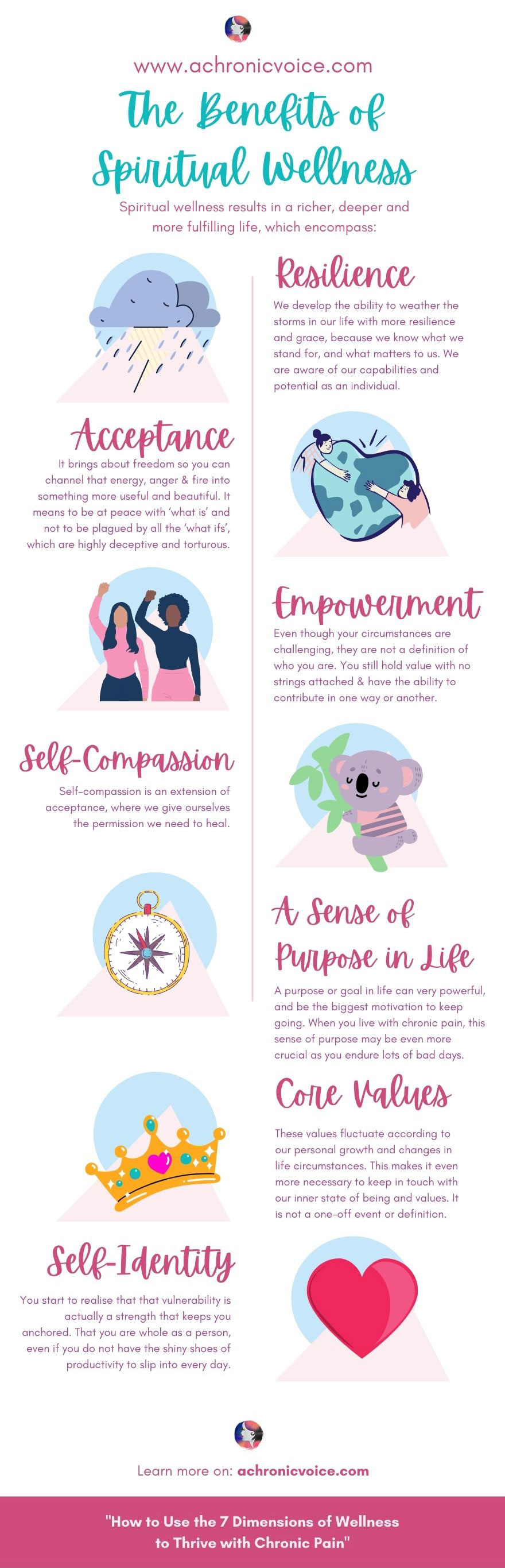
### Holistic Ways to Improve Spiritual Wellness
Spiritual wellness is not a task to be 'done and dusted'; None of the dimensions of wellness really are. A daily routine for checking-in with your spiritual health is best.
The closer you look into something, the more you find. The longer you observe something, the more you realise. A bit of a mix between a detective and a monk (my own definition).
- **Mindfulness**
Some people are suspicious of mindfulness as they view it as an emptying of the mind. But there are [differences between mindfulness and meditation](https://medium.com/thrive-global/mindfulness-meditation-whats-the-difference-852f5ef7ec1a) (Shapiro & Shapiro, 2017), which I’ll cover next. Mindfulness is hardly a passive process, but an active one inside our brains. It is an observation of life as it is in the present moment, with no holds barred. It doesn’t require you to sit in a meditative posture, chant, or otherwise do something otherworldly.
The emphasis is on observance and focus. To acknowledge our thoughts and emotions as they rise, then let them go without judgment. To keep bringing our thoughts back to the present moment. You can be mindful whilst eating, walking, and doing other mundane chores or routine tasks. This enables us to be more self-aware of the ‘what’ and ‘why’ that drive our behaviours, thoughts and actions. It can bring about clarity, and help us to make better choices.
[Dialectical Behaviour Therapy](https://pmc.ncbi.nlm.nih.gov/articles/PMC2963469/) (DBT) is based on mindfulness (Chapman, 2006). It is one method used by clinicians to help their clients cope better with a myriad of mental and mood problems.
Some studies have also shown that mindfulness can help to alleviate stress, release endorphins, reduce high blood pressure and more. To quote from [Jon Kabat-Zinn’s book, “The Unexpected Power of Mindfulness and Meditation”](https://www.amazon.com/dp/0486831825?&linkCode=ll1&tag=achronicvoice-20&linkId=582aa7ba0f6544588ec16ebc18b176dc&language=en%5FUS&ref%5F=as%5Fli%5Fss%5Ftl):
> “Mindfulness, which includes tenderness and kindness toward ourselves, restores dimensions of our being. These have never actually been missing, just that we have been missing them, we have been absorbed elsewhere. When your mind clarifies and opens, your heart also clarifies and opens.”
- **Meditation**
There are a dozen [forms of meditation](https://positivepsychology.com/differences-between-mindfulness-meditation/) out there (Schultz, 2020). From mindfulness meditation, to Zen meditation, to transcendental meditation. Each has their own unique emphasis and employs different methods. Which meditation practice should you pick up? That's entirely dependent on your aims and what you're comfortable with.
Some forms of meditation are focused on being more mindful, others on achieving enlightenment and wisdom, and yet others on accumulating self-knowledge. In general however, meditation has been proven to help with stress and anxiety management, and increase attention spans. Some studies have shown that meditation can be as effective as taking antidepressants.
Brain scans have even shown that [those who meditate regularly have more grey matter](https://www.ncbi.nlm.nih.gov/pmc/articles/PMC1361002/) in their brains, which indicates better preservation of the brain (Lazar et al., 2005). Studies have also showed that [mindfulness meditation decreases activity in the default network mode](https://medicine.yale.edu/news/yale-medicine-magazine/new-study-finds-links-between-meditation-and-brain/) (DNM). This is often referred to as the “monkey mind”, which gets easily distracted (Yale Medicine Magazine, 2012). Whilst studies have yet to confirm the effects of meditation on addiction, some results seem positive. This may have to do with the practice of [‘decoupling’ the craving from the act in itself](https://www.dovepress.com/mindfulness-meditation-in-the-treatment-of-substance-use-disorders-and-peer-reviewed-fulltext-article-SAR), until it has passed (Priddy et al., 2018).
> “I have lived on the lip of insanity, wanting to known reasons, knocking on the door. It opens. I’ve been knocking from the inside.” - Rumi
- **Travel**
Travelling is a great way to explore new cultures, ways of thinking, meet all sorts of people and expand our general knowledge. This can be a liberating experience, as you come to realise that there's no such thing as 'normal'; values vary from culture to culture, and person to person.
Whilst it's hard to travel much these days with the pandemic, the good news is that many educational and travel sites have gone virtual. From art museums, to nature parks, to cities and more. (Here are [101 ways to travel without leaving your house from Condé Nast](https://www.cntraveler.com/story/101-ways-to-travel-without-leaving-your-house) (2020).) People with chronic illness and disability are actually celebrating this unintended increase in accessibility. Hopefully such opportunities for armchair travelling will be a permanent feature!
Read Related Posts:
- [Top Tips for Travelling with Chronic Illness & Disability (From a Girl Who Loves to Travel)](https://achronicvoice.com/travelling-with-chronic-illness-disability/)
- [There’s No One Way to Live Your Life](https://achronicvoice.com/no-one-way-live-your-life/)
- [Coming Alive in the Winter Air (Pushing for Personal Changes & Group Advocacy)](https://achronicvoice.com/winter-advocacy/)
- [Travelling New Paths with Chronic Illnesses in My Pocket](https://achronicvoice.com/travelling-new-paths-chronic-illness/)
- [Tell Me You’re Chronically Ill Without Telling Me You’re Chronically Ill (52 Chronic Illness Memes)](https://achronicvoice.com/chronic-illness-memes/)
- **Journaling**
Journaling is a spiritual practice for many, as **[writing forces you to slow down](https://achronicvoice.com/quarterly-reflection-life-lessons-learned/)**, or helps you to express your thoughts and feelings. It can be a reflective and revelatory process. Calming or distracting at the very least, and epiphanic at best.
- **Reading**
**[Reading is another form of armchair, mind and time travel](https://achronicvoice.com/useful-things-to-do-while-on-bed-rest/)**. We may be reading a book about an entirely foreign culture or past civilisation. Perhaps a historical narrative, or even enter imaginary worlds through fantasy. This can lead us down the road of self-reflection once again. We may be perplexed by the choices the characters in the story make, root for them, relate to them, or harbour some other feeling. This can reveal a lot about our own values, prejudices and personal character traits, too.
- **Spending Time in Nature**
Nature truly is a healer, and benefits all dimensions of wellness in so many ways. Many retreat to nature for respite, stress relief and solitude. The quiet time and leisurely pace allows us the space and time to regain our footing in life, and get in touch with our inner self again. To be up close to the beauty and wonders of life can be awe-striking and bring about hope and joy as well.
- **Taking Yourself Out for ‘Dates’ or Carving Out ‘Me-Time’**
You don't need someone else to take you out on a date. **[Romance yourself](https://achronicvoice.com/healthy-relationship-with-body-chronic-illness/)**. The best part about it? No compromises required - you can do and have all your favourite things! Spending quality time with yourself is vital for recharging your mental, emotional and spiritual batteries.
Simply enjoying a cup of coffee alone whilst watching the world go by is one of my favourite things to do. I spend time observing passersby, wondering about their lives. This activity (or non-activity) in itself helps me to relax. It also helps me to 'regroup' from all the busyness in my life that takes up space and energy.
My spoonie friend, Claire of 'Through the Fibro Fog', seems to agree as she goes out on ‘[London dating herself days](https://www.throughthefibrofog.com/dating-yourself-chronic-illness/)’, too (at least before the pandemic!).
Pin to Your Self-Care & Self-Love Boards:
Pin to Your Spiritual Wellness & Infographics Boards:
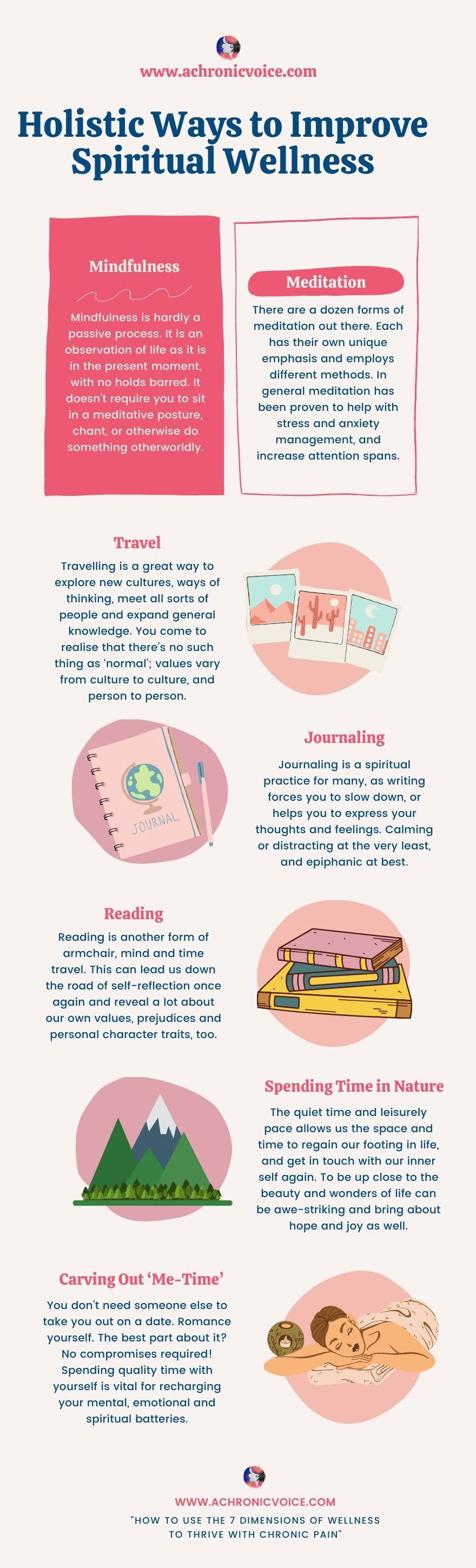
## The Seventh (and Final!) Dimension of Wellness – Occupational Wellness
I believe that as humans, we were born to work. Not work in the sense of a career, although career falls under the same umbrella. But work as in doing something useful that feels rewarding. Both as a contribution to society or to others, and also for your own self-esteem and happiness.
Many with chronic illness or disability have had to give up professions that they love. Many of us even consider the ability to have work stress as a ‘luxury problem’ or a blessing in itself. It means that our bodies are functioning at full capacity.
When the ability to earn an income is taken away from us, it can feel demoralising. Who are we, when we have no ability to contribute financially, or to produce? But there are other ways to feel a sense of accomplishment through work.
Read Related Posts:
- [Why ‘Easy’ Part-Time Jobs are Not That Easy for Those with Chronic Illness](https://achronicvoice.com/part-time-jobs-not-easy-chronic-illness/)
- [“It’s in My Blood”: Featuring People with Illnesses, Passions & Talents](https://achronicvoice.com/its-in-my-blood-people-illnesses-talents/)
- [The Barriers That Throw Rocks into My Bucket List with Chronic Illness](https://achronicvoice.com/bucket-list-chronic-illness/)
- [Useful Things to Do While on Bed Rest After Surgery: Education, Advocacy & Volunteering](https://achronicvoice.com/useful-things-to-do-while-on-bed-rest/)
- [Chronic Stress, the Silent Assassin](https://achronicvoice.com/chronic-stress-silent-assassin/)
### Signs of Occupational Wellness
Time seems to fly by when you’re working on something that you love, doesn’t it? We become so absorbed with the process, and the final result feels like an accomplishment that you can be proud of.
Here are some signs of what it means to have occupational wellness:
- [Doing work that is meaningful to you](https://www.forbes.com/sites/rodgerdeanduncan/2018/09/11/the-why-of-work-purpose-and-meaning-really-do-matter/?sh=4363e48568e1), and brings you a sense of [job satisfaction](https://oem.bmj.com/content/62/2/105), accomplishment and happiness (Duncan, 2018; Faragher et al., 2005).
- Pacing, knowing your boundaries and having [a healthy work-life balance](https://www.oecdbetterlifeindex.org/topics/work-life-balance/) (Organisation for Economic Co-operation and Development \[OECD\], n.d.).
- Working in a way that maximises your energy, your learning and working styles.
- Collaborating and communicating clearly and constructively with those whom you work with.
- Feeling challenged at work in a way that inspires you, and not leads to burnout.
- Going home or to bed after work, knowing that you did a good job.
Pin to Your Occupational Wellness & Infographic Boards:
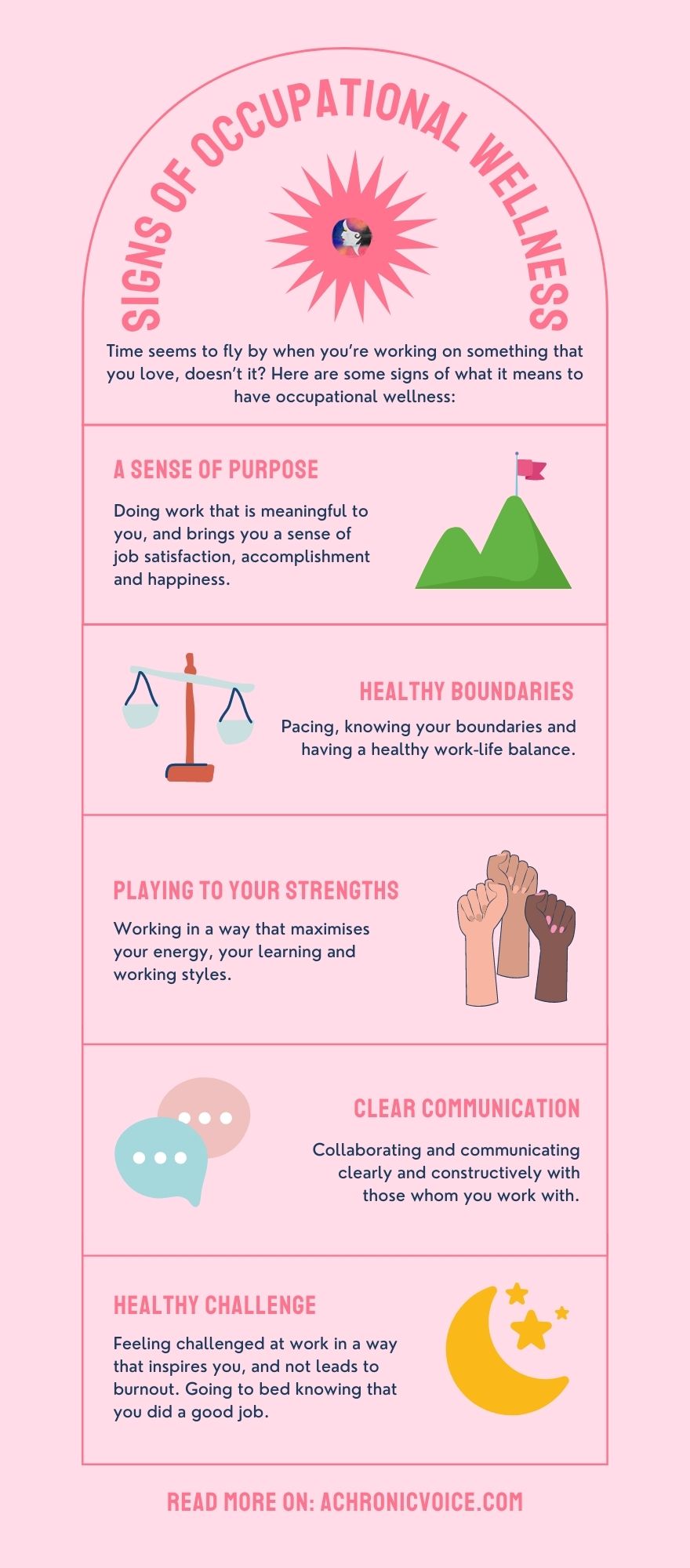
### Common Career Crisis Reasons
Many people hit a mid-life crisis (or even at a younger age these days), where they just up and switch career paths. I've read many 'About' pages of entrepreneurs who claim that they did so for a variety of reasons, common ones being:
- They were sick of working overtime, all the time, and basically having no life.
- They felt like their career wasn't one that brought them any life satisfaction, or that it didn't contribute to society in a positive way.
- They realised that they had been doing what everyone else did, or what their parents wanted, instead of what they truly loved.
- They had a brilliant idea that they were excited to share with the world.
### Holistic Ways to Improve Occupational Wellness
Here are some ways we can strive to achieve occupational wellness, despite chronic illness or disability:
- **Finding Ways to Accomplish Our Career Goals**
Chronic illness not only robs us of our health. It can also rob us of our ability to work, amongst many other things. Whilst brain fog and brain injuries may flirt with our memories, chronic pain and disability cannot rob us entirely of knowledge and experience that we have earned along the way. Many patients even become [more knowledgeable than the average doctor](https://www.medpagetoday.com/blogs/drrob/21266) about their chronic conditions (Rob, 2010).
Are there opportunities to continue practising and expanding your knowledge in one capacity or another? If you are an employer, what can you do to [promote occupational wellbeing for your employees](https://www.healthaffairs.org/doi/10.1377/hlthaff.2016.1150) (McLellan, 2017)? Doing so not only increases their quality of life, but the over all health of your business.
I remember needing to quit my job in advertising as **[the stress was outright killing me](https://achronicvoice.com/chronic-stress-silent-assassin/)**. I had lived an entire year on a red blood cell count that technically could use a few blood transfusions. The only reason that I could still breathe normally was that my body had acclimated to the low oxygen levels, as if I had hiked up Mount Everest. (I am always amazed by my body in that regard.) Finally, I gave in and took a three month unpaid leave. I shouldn't have been surprised at the 'miraculous' improvement in my health. I knew right there and then that I had to quit my job.
What this led to is a 10 year career in the same line of work but as a freelancer, which I learned that I enjoyed even better than working full-time! It fitted my style of working. And the time saved on commute and acting ‘normal’ in the office meant that I could use that energy to do productive work instead. Whilst I still struggle to cope with the workload and unstable income, the ability to have a say has been crucial for my over all wellbeing. Both in terms of occupational wellness, and all dimensions of health.
> “When one door of happiness closes, another opens, but often we look so long at the closed door that we do not see the one that has been opened for us.” — Helen Keller
> “If your actions inspire others to dream more, learn more, do more and become more, you are a leader.” — John Quincy Adams
- **Exploring Careers that Fill You with Purpose and/or Happiness**
If you are well and fortunate enough to pursue a career path, it can be a good idea to assess if it's one you actually enjoy. Or is there another career path you can explore? One that will introduce more joy and purpose in your life?
> “If you are working on something exciting that you really care about, you don’t have to be pushed. The vision pulls you.” — Steve Jobs
- **Maximising Your Potential at Work**
If your job already brings you fulfilment - which can mean different things to different people - is there a way to better yourself even more? Is there a way to breathe your personality and talents into what you do? Is there a way to expand your interests and potential? Are there people at your workplace on the same wavelength as you that you can explore interesting ideas, concepts or projects with?
> “The quality of a person’s life is in direct proportion to their commitment to excellence, regardless of their chosen field of endeavor.” — Vince Lombardi
- **Picking Up New Skills**
**[You don't know what you're capable of and what you may actually enjoy without trying](https://achronicvoice.com/capable-person-meaning/)**, can you? Just like how people acquire a taste for food, even though they may seem 'disgusting' at first bite, we can also acquire a taste for new interests.
Picking up a new skill is beneficial for and touches on all the dimensions of wellness. It may eventually even lead to a new career path that you love; I know people in real life who have done this, and have never looked back. Regardless of career prospects, picking up a new skill helps with self-improvement, expands our knowledge, and can give us a sense of fulfilment by working on it.
> “I’ve learned so much from my mistakes... I’m thinking of making a few more.” – Unknown
Pin to Your Self-Improvement & Motivational Quotes Boards:
- **Working on a Hobby**
I know a number of people with chronic illness and disability who love craftwork, and have set up Etsy stores to sell their products. It's a great way to work on something, feel good about it, and even earn some money! Some have transformed their hobbies into a freelance business, or companies end up commissioning them for work after seeing their creations on social media. Even if you don't work on a hobby to sell something, it can bring about a great sense of satisfaction and feel rewarding. (**[View this post for a comprehensive list of hobbies you can do](https://achronicvoice.com/fun-things-to-do-while-recovering-from-surgery-hobbies-crafts-games-part-3-5/)**.)
- **Blogging**
I had to throw this one in, of course. Those who do not blog have no idea how much work blogging actually is! Writing is probably the 'easiest' part. Then there's graphic creation, SEO optimisation, post promotion and social media interaction. The hours spent can be on par to a full-time job. Yet blogging has been one of the most fulfilling things I have done in my life.
I started my blog during a very difficult period in my life, where I was in and out of the Emergency Department every few days. Blogging gave and gives me an outlet to share, contribute to society, and raise awareness. It's especially gratifying when a blog post helps another person with chronic pain or disability out there.
Read Related Posts:
- [MediSearch Review: A Medical AI Search Engine for Patients, Clinicians & Medical Writers](https://achronicvoice.com/medisearch-review-medical-ai-search-engine/)
- [The Power and Purpose of Blogging, and Why You Should Write](https://achronicvoice.com/purpose-of-blogging/)
- [Why I Write, Even Though it Makes Me Uncomfortable](https://achronicvoice.com/why-i-write/)
- [A Quarterly Reflection: 12 Important Life Lessons I’ve Learned](https://achronicvoice.com/quarterly-reflection-life-lessons-learned/)
- [12 Chronic Illness Bloggers Share Their Top Posts for 2020](https://achronicvoice.com/chronic-illness-bloggers-top-posts-2020/)
Pin to Your Occupational Wellness & Infographics Boards:
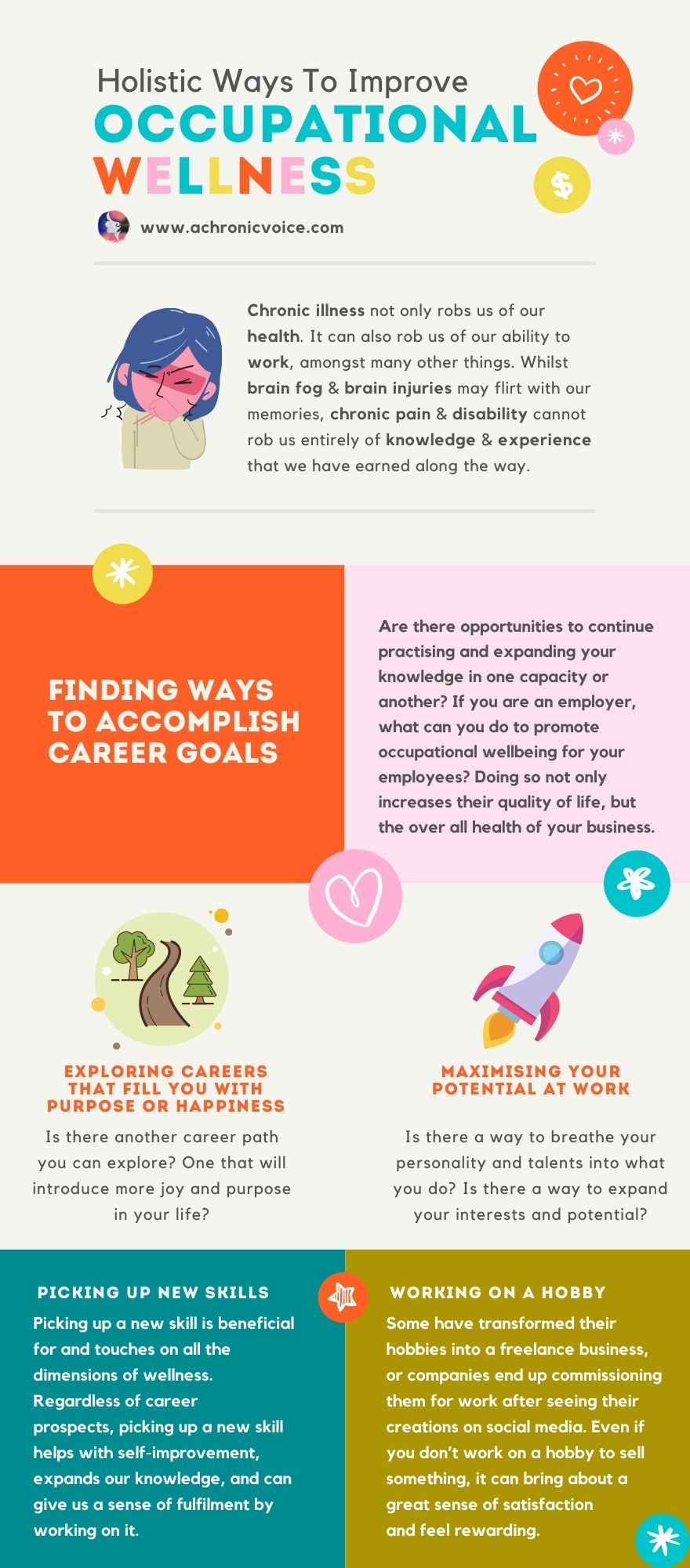
## In Conclusion to the 7 Dimensions of Wellness
Admittedly, I hadn’t intended to write *this* much about the seven dimensions of wellness! I guess it only goes to show the complexity and interrelationship of everything that goes on, both within and around us. And the need to nurture all the dimensions of wellness, so that we can thrive to our fullest possible extent in this one life we have.
Chronic pain is a monster consumer of energy. Disability and chronic pain often leave us feeling defeated, as our body doesn’t work as intended. It is all too easy to slide down that slippery slope of self-destruction and to perpetuate a poisonous cycle that seeps into all aspects of our lives. This only wreaks more damage and havoc on our health and wellbeing.
It is therefore, of even more urgency that we pay full attention to all the dimensions of wellness. ***‘Health is wealth’. And health is physical, mental, emotional, spiritual, intellectual, occupational and social wealth all rolled into one.***
## Sign Up for My Free Newsletter
Be the first to get the latest post updates in your inbox, and unlock the comments section. You will also receive an e-book full of uplifting messages, quotes and illustrations as a token of appreciation!
[Browse more membership plans here](#/portal/), or [make a one-off donation](https://ghost.achronicvoice.com/#/portal/support) instead.
Sign Up
Email sent! Check your inbox to complete your signup.
No spam. Unsubscribe anytime.
Pin to Your 7 Dimensions of Wellness, Chronic Illness & Mental Health Boards:
### References:
- 80,000 Hours. (n.d.). *Effective altruism: An introduction.* Retrieved June 2, 2025, from
- Ackerman, C. E. (2018, February 12). *Cognitive restructuring techniques for reframing thoughts.* PositivePsychology.Com.
- American Art Therapy Association. (n.d.). *About art therapy.* Retrieved May 24, 2021, from
- American Psychological Association. (n.d.). *Resilience.* apa.org. Retrieved May 24, 2021, from
- Beck, J. (2015, October 22). *How friendships change when you become an adult.* The Atlantic.
- Bentsen, P., & Jensen, F. S. (2012). The nature of udeskole: Outdoor learning theory and practice in Danish schools. *Journal of Adventure Education and Outdoor Learning, 12*(3), 199–219\.
- Better Health Channel. (n.d.). *Strong relationships, strong health.* Department of Health, State Government of Victoria; Department of Health & Human Services. Retrieved 2 June 2025, from
- Better Health Channel. (2021, July 29). *Complementary therapies.* Department of Health, State Government of Victoria; Department of Health & Human Services.
- Bhandari, S. (2024, September 8). *Guide to psychiatry and counseling.* WebMD.
- Bilodeau, K. (2021, May 10). *5 inflammation-fighting food swaps.* Harvard Health.
- Bood, S. A., Sundequist, U., Kjellgren, A., Nordstrom, G., & Norlander, T. (2005). Effects of flotation-restricted environmental stimulation technique on stress-related muscle pain: What makes the difference in therapy--attention-placebo or the relaxation response? *Pain Research & Management, 10*(4), 201–209\.
- Booth, S. (2019, May 14). *Brain Health With Binaural Beats.* Healthline.
- Chan, S. (n.d.). *Pain awareness through journaling, and using it to manage chronic pain.* Pathways. Retrieved May 24, 2021, from
- Chapman, A. L. (2006). Dialectical behavior therapy. Psychiatry *(Edgmont), 3*(9), 62–68\.
- Chopra, S. (n.d.). *Skin & hair care for those with chronic conditions—’student of the land’* \[Video\]. Retrieved May 24, 2021, from
- Chopra, S. (n.d.). *Spoonie thoughts: Does chronic illness change you?* All Things Endometriosis. Retrieved May 24, 2021, from
- Clark, K. (2020, October 24). *Smile power! Emotional and physical healing.* Pain FULLY Living.
- Condé Nast Traveler. (2020, March 20). *101 Ways to Travel Without Leaving Your House.*
- Das, D. (2018, July 3). *Meet Dr. Qing Li – the man who wants you to walk more in the forests for your own benefits.* Life Beyond Numbers.
- Djikic, M., & Oatley, K. (2014). The art in fiction: From indirect communication to changes of the self. *Psychology of Aesthetics, Creativity, and the Arts, 8*(4), 498–505\.
- Domonell, K. (2016, January 13). *Why endorphins (and exercise) make you happy.* CNN Health.
- Donvito, T. (2018, October 20). *Got painsomnia? These 9 patient-tested tips may help you sleep well again.* CreakyJoints.
- Duncan, R. D. (2018, September 11). *The why of work: Purpose and meaning really do matter.* Forbes.
- Economy, P. (2019, March 26). *5 remarkably powerful hacks to become more articulate (you don’t have to give a TED talk to do it).* Inc.
- Ernst, E. (2007). Holistic health care? *The British Journal of General Practice, 57*(535), 162–163\.
- Fahkry, T. (2018, February 5). *How to embrace vulnerability as your greatest strength.* Mission.Org.
- Faragher, E. B., Cass, M., & Cooper, C. L. (2005). The relationship between job satisfaction and health: A meta-analysis. *Occupational and Environmental Medicine, 62*(2), 105–112\.
- Glantz, J. (2019, June 26). *I tried laughing yoga—And what I learned about myself surprised me.* NBC News.
- Goldsmith, B. (2013, October 16). *Feelings aren’t facts.* Psychology Today.
- Golics, C. J., Basra, M. K. A., Finlay, A. Y., & Salek, S. (2013). The impact of disease on family members: A critical aspect of medical care. *Journal of the Royal Society of Medicine, 106*(10), 399–407\.
- Guendelman, S., Medeiros, S., & Rampes, H. (2017). Mindfulness and emotion regulation: Insights from neurobiological, psychological, and clinical studies. *Frontiers in Psychology, 8*, 220\.
- Harvard Health Publishing. (2016, May 16). *Greater self-acceptance improves emotional well-being.* Harvard Health.
- Harvard Health Publishing. (2021, February 3). *5 weight training tips for people with arthritis.* Harvard Health.
- Harvard Health Publishing. (2024, April 3). *Foods linked to better brainpower.* Harvard Health.
- He, C.-H., Yu, F., Jiang, Z.-C., Wang, J.-Y., & Luo, F. (2014). *Fearful thinking predicts hypervigilance towards pain-related stimuli in patients with chronic pain.* PsyCh Journal, 3(3), 189–200\.
- Health Canada. (2022, May 3). *Limit highly processed foods.* Government of Canada.
- Healthdirect Australia. (2023, August). *7 ways pets improve your mental health.* Healthdirect Australia.
- Heid, M. (2018, September 19). *Does thinking burn calories? Here’s what the science says.* TIME.
- Hestbech, A. M. (2018). Reclaiming the inner child in cognitive-behavioral therapy: The complementary model of the personality. *American Journal of Psychotherapy, 71*(1), 21–27\.
- Iannotti, M. (2024, May 28). *The 22 best, easiest houseplants that grow great in any home.* The Spruce.
- Ivey, C. (2019, June 1). *Please don’t say ‘mental health’ when what you mean is ‘emotional health’.* Psychreg.
- Karnilowicz, W. (2011). Identity and psychological ownership in chronic illness and disease state. *European Journal of Cancer Care, 20*(2), 276–282\.
- Kataria, M. (n.d.). *Laughter yoga international: Promoting health, happiness, and peace through laughter.* Laughter Yoga International. Retrieved May 24, 2021, from
- Kellenberger, C. (2020, June 15). *Tips & tricks volunteer work when you are chronically ill.* My Several Worlds.
- Kiva. (n.d.). *Make a loan, change a life.* Retrieved May 24, 2021, from
- Kupcova, I., Danisovic, L., Klein, M., & Harsanyi, S. (2023). Effects of the COVID-19 pandemic on mental health, anxiety, and depression. *BMC Psychology, 11*(1), 1-7\.
- Lazar, S. W., Kerr, C. E., Wasserman, R. H., Gray, J. R., Greve, D. N., Treadway, M. T., McGarvey, M., Quinn, B. T., Dusek, J. A., Benson, H., Rauch, S. L., Moore, C. I., & Fischl, B. (2005). Meditation experience is associated with increased cortical thickness. *Neuroreport, 16*(17), 1893–1897\.
- Leslie, I. (2020, July 3). *Why your ‘weak-tie’ friendships may mean more than you think.* BBC.
- Li, Q. (2010). Effect of forest bathing trips on human immune function. *Environmental Health and Preventive Medicine, 15*(1), 9–17\.
- Li, Q. (2018, LiMay). *The benefits of ‘forest bathing’.* TIME.
- Martino, J., Pegg, J., & Frates, E. P. (2015). The connection prescription: Using the power of social interactions and the deep desire for connectedness to empower health and wellness. *American Journal of Lifestyle Medicine, 11*(6), 466–475\.
- McLellan, R. K. (2017). Work, health, and worker well-being: Roles and opportunities for employers. *Health Affairs, 36*(2), 206–213\.
- McManus, K. D. (2019, April 25). *Phytonutrients: Paint your plate with the colors of the rainbow.* Harvard Health.
- Mental Health Foundation. (2021, August 13). *Mindfulness.*
- Mullins, P. M., Yong, R. J., & Bhattacharyya, N. (2023). Associations between chronic pain, anxiety, and depression among adults in the United States. *Pain Practice, 23*(6), 589–594\.
- National Academies of Sciences, Engineering, and Medicine. (2019). The science of mentoring relationships: What is mentorship? In M. Dahlberg & A. Byars-Winston (Eds.), *The science of effective mentorship in STEMM.* National Academies Press.
- National Institutes of Health. (2017, February). *Do social ties affect our health?* NIH News in Health.
- NIH News in Health. (2021, April). *Good sleep for good health.* National Institutes of Health.
- NY Book Editors. (n.d.). *Why writers should read other genres.* Retrieved May 24, 2021, from
- Organisation for Economic Co-operation and Development. (n.d.). *Work-life balance.* OECD Better Life Index. Retrieved June 3, 2025, from
- Ozbay, F., Johnson, D. C., Dimoulas, E., Morgan, C. A., Charney, D., & Southwick, S. (2007). Social support and resilience to stress. *Psychiatry (Edgmont), 4*(5), 35–40\.
- Patwardhan, B., Mutalik, G., & Tillu, G. (2015). Chapter 3—Concepts of health and disease. In B. Patwardhan, G. Mutalik, & G. Tillu (Eds.), *Integrative Approaches for Health* (pp. 53–78). Academic Press.
- Plummer, J. (2020, April 22). *Why relationships matter (maybe now more than ever).* Syracuse University News.
- Priddy, S. E., Howard, M. O., Hanley, A. W., Riquino, M. R., Friberg-Felsted, K., & Garland, E. L. (2018). Mindfulness meditation in the treatment of substance use disorders and preventing future relapse: Neurocognitive mechanisms and clinical implications. *Substance Abuse and Rehabilitation, 9*, 103–114\.
- Rampton, J. (2017, August 21). *The benefits of playing music help your brain more than any other activity.* Inc.
- Ridley, A., & Zwald, D. (2021, December 3). *Athens news matters: Charitable giving - volunteering vs. donating.* WUGA | University of Georgia.
- Rob. (2010, July 20). *A letter to patients with chronic illness.* MedPage Today.
- Robbins, J. (2020, January 9). *Ecopsychology: How immersion in nature benefits your health.* Yale Environment 360\.
- Santos-Longhurst, A. (2023, July 12). *Why is oxytocin known as the ‘love hormone’? And 11 other faqs.* Healthline.
- Sarkis, S. A. (2020, January 23). *Discover 8 journaling techniques for better mental health.* Psychology Today.
- Schultz, J. (2020, July 24). *Mindfulness vs meditation: 5 crucial differences.* PositivePsychology.Com.
- Schwartz, E. (2025, May 9). *The very best indoor-garden kits.* The Strategist.
- Sedghi, A. (2018, April 30). *Loneliness isn’t inevitable – a guide to making new friends as an adult.* The Guardian.
- Segal, J., & Robinson, L. (2018, November 2). *Volunteering and its surprising benefits.* HelpGuide.Org.
- Shapiro, E., & Shapiro, D. (2017, May 23). *The difference between mindfulness and meditation.* Thrive Global.
- Shearer, D. (2019, December 4). *How controlled breathing helps elite athletes – and you can benefit from it too.* The Conversation.
- Shevellar, L., Sherwin ,Jane, & and Barringham, N. (2014). The human search for belonging. *Journal of Spirituality in Mental Health, 16*(1), 2–18\.
- Slatalla, M. (2022, November 4). *10 things nobody tells you about air plants.* Gardenista.
- Solodar, J. (2025, January 31). *Sleep hygiene: Simple practices for better rest.* Harvard Health.
- Spector, N. (2018, January 10). *Smiling can trick your brain into happiness—And boost your health.* NBC News.
- Stibich, M. (2024, January 1). *How to Use the SMART Goals Template.* Verywell Mind.
- Stoewen, D. L. (2017). Dimensions of wellness: Change your habits, change your life. *The Canadian Veterinary Journal, 58*(8), 861–862\.
- Stuckey, H. L., & Nobel, J. (2010). The connection between art, healing, and public health: A review of current literature. *American Journal of Public Health, 100*(2), 254–263\.
- Suchomel, T. J., Nimphius, S., Bellon, C. R., & Stone, M. H. (2018). The importance of muscular strength: Training considerations. *Sports Medicine, 48*(4), 765-785\.
- Suni, E. (2024, May 9). *Mouth and throat exercises to help stop snoring and improve OSA.* Sleep Foundation.
- Swift, M. H. (1973, January). *Clear writing means clear thinking means…*. Harvard Business Review.
- Tabrizi, N. M., & Morgan, S. (2014). Models for describing knowledge sharing Practices in the healthcare industry: Example of experience knowledge sharing. *International Journal of Management and Applied Research, 1*(2), 48-67\.
- TIME. (n.d.). *Behind the strange new science of floating.* Retrieved May 24, 2021, from
- Tiret. (2023, June 8). *The benefits art therapy can have on mental and physical health.* Michigan State University.
- Torrens, K. (2024, March 6). *Top 5 health benefits of nuts.* goodFOOD.
- Trunzo, J. (2019, September 30). *The best life possible.* Aeon.
- Umberson, D., & Montez, J. K. (2010). Social relationships and health: A flashpoint for health policy. *Journal of Health and Social Behavior, 51*(Suppl), S54–S66\.
- University of New Hampshire. (2020, March 19). *Spiritual wellness.*
- VisitDenmark. (n.d.). *What is ‘hygge’?* Retrieved May 24, 2021, from
- Woods, R. F. (2018, August 31). *14 Benefits of Practicing Acceptance.* Psych Central.
- Yale Medicine Magazine. (2012). *New study finds links between meditation and brain functions.* Yale School Of Medicine.
- Zeppieri, M. (2018, October 13). *10 Ways to Help Those in Need Despite Chronic Illness.* Lupus Chick.
### Comments Archives:
Comments imported from previous WordPress site.
- Nikki Albert Nov 26, 2021
I am a firm believer in taking care of our entire embodied beings which means all these factors… which are also life satisfaction factors. I often talk about these myself because sometimes when we are chronically ill we focus heavily on one or two because we are so keenly aware those are lagging behind… but if we focus on our entire being it can really help overall. Sometimes just bit by bit with small changes too. This is such a thorough guide to that effect. I’m going to share it with my followers. Thank you for putting such thoughtful work into it! You rock!!!
- [ Sheryl Chan ](https://achronicvoice.com/) Nov 29, 2021
Thank you so much Nikki! The irony of writing this post was it caused a pain flare hahaha! I really need to take my own advice… and totally agree. I too (even though I wrote this post!) need to practice more of incorporating all the dimensions of wellness. Make it a habit. Because at the end of the day, it’s all about habits, isn’t it?
- Lucy Aug 16, 2021
This is such a detailed and comprehensive article Sheryl, thank you. I especially like you way you’ve highlighted the importance of spiritual, social, intellectual and occupational wellness, which don’t receive as much attention as physical and mental health. You provide such a range of activities for each dimension so there’s something for everyone.
- [ Sheryl Chan ](https://achronicvoice.com/) Aug 21, 2021
Thank you Lucy! Yes they are all such important dimensions but I think modern society, especially in Western cultures, neglect the spiritual side of things a lot, though it seems to be changing in recent years. I guess, like it says in the article, that people often confuse spiritual wellbeing with spirituality or religion, which can be different things. Hope this article is helpful to you!
- [ Carrie Kellenberger ](https://myseveralworlds.com) Aug 16, 2021
Wonderful, comprehensive, and BEAUTIFUL post, Sheryl. I love how you break each dimension down to explain all of this. This is a ‘one-stop shopping’ guide to wellness and you did a great job!
“Chronic pain is a monster consumer of energy. Disability and chronic pain often leave us feeling defeated, as our body doesn’t work as intended.” This part really resonated with me because I’m really feeling it again this summer. Going back and forth between what is the point and there is a point to all of this. I needed to read this today!
- [ Sheryl Chan ](https://achronicvoice.com/) Aug 21, 2021
I’m sorry that the parts that resonated with you were about pain 🙁 Really hope you get back to a more reasonable baseline soon. And thank you… I actually ran into a pain flare just piecing this post together – the irony. But I’m happy to have done it! 🙂
- [ Max Russell ](https://jerseyrehab.com/) Jul 27, 2021
Sheryl, you’ve written a wonderful article! Living with a disability or chronic pain requires patience and a strong desire to live a happy and fulfilled life. I advise people to make positive lifestyle adjustments such as taking a balanced diet, adequate sleep, mental relaxation, yoga practice, and emotional bonding with friends and family.
- [ Sheryl Chan ](https://achronicvoice.com/) Aug 6, 2021
Thanks for doing your part!
- Katie Clark Jun 29, 2021
You’ve captured the complexity of chronic pain. It’s not just get a pill, and things will be fine. It’s really hard to explain to friends and family because literally, they aren’t able to grasp the whole picture. When we try to share just one part, it makes it seem so simple. This is why I say it’s a full time job to work on these 7demensions. I wonder if it will ever be less demanding?
- [ Sheryl Chan ](https://achronicvoice.com/) Jul 27, 2021
I couldn’t agree more – pain can sound so simplistic when people only understand it as acute physical pain, or ‘some sort of’ mental pain. It certainly is a lifelong, full time job working on these dimensions, indeed!
- [ Claire ](http://throughthefibrofog.com) Jun 23, 2021
Such a comprehensive post – so helpful!
I totally agree that wellness isn’t just ‘one thing’ and is so many aspects of our lives, that often inter-connect. I’ve found that being outside and in nature in the woods or just at a local park is one of the best ways to perk up my mood and make me feel better.
- [ Sheryl Chan ](https://achronicvoice.com/) Jul 27, 2021
I wish we had woods or larger greenery here, and less humidity. I bet you I’d be walking and going outdoors SO much more, and no – truly isn’t an excuse! :p
- [ Heather @ Writer's Life for You ](https://writerslifeforyou.com/) Jun 14, 2021
First of all, this is an amazing article! I had never heard of the 7 dimensions of wellness but as soon as you mentioned them I saw that they all do work together. I need to work on several of these, especially spiritual. I want to start meditating more because I feel like I’m always so busy and that would really help. I recently started yoga for the physical aspect because sometimes finding an exercise you can do when you have a chronic illness can be so difficult. I’m bookmarking this article!
- [ Sheryl Chan ](https://achronicvoice.com/) Jun 14, 2021
Thank you for sharing your personal experiences, plans and for bookmarking this article, Heather! Yes there are a few different numbers for the dimensions of wellness but I thought these seven were the best fit! I do need to work on my spiritual health, too. As mentioned in the article, it’s not about ‘woo woo’ stuff, but being in touch with my inner self and more. I wish you all the best on your journey!
- [ Beth Elkassih ](https://madeyousmileback.com) Jun 13, 2021
Thanks for sharing this well detailed and written article. I particularly like your definition of emotional and mental well-being and yes, yes, yes, I am a big proponent of journaling.
- [ Sheryl Chan ](https://achronicvoice.com/) Jun 14, 2021
Thank you Beth! I did a lot of research to ensure that the definitions were as accurate as possible, and also my own personal take on them based on experiences with chronic pain. And journaling is a fantastic tool indeed for many things!
- [ Myrah Duque ](https://www.mamacitaonthemove.com) Jun 13, 2021
First of all, THANK YOU for this in-depth article about dealing with chronic pain! It has definitely helped me in the way I now look at living with chronic pain. It’s such a health challenge that many live with and we don’t stop to think about it. Definitely sharing this article.
- [ Sheryl Chan ](https://achronicvoice.com/) Jun 13, 2021
Thanks so much, Myrah! I’m glad it helps you in some way or another. Chronic pain and the management for it definitely differs from person to person, and encompasses beyond just getting better from physical pain. Hope your pain eases up a little bit!
- [ Elaine Merryfield ](http://navigatinglifewithfibro.com) Jun 8, 2021
This is such a comprehensive and helpful article/ post that you wrote here about living with chronic heath challenges and all the dimensions of our lives that are interconnected and interdependent. It took me years to learn this so I see this as such valuable info for those earlier on in their journeys. Blessing to you for this valuable contribution.
- [ Sheryl Chan ](https://achronicvoice.com/) Jun 9, 2021
Thank you Elaine! It was a tough one to write as it required quite a bit of research for a blog post, but one I was so glad to do 🙂 Yes health really goes beyond just the physical, doesn’t it? Those with chronic illness definitely know the mental, occupational and emotional impact at the minimum for one.
- [ Despite Pain ](https://despitepain.com) Jun 6, 2021
Sheryl, I have never before read such a good, in depth article about coping with chronic pain. You have covered so much and gone into so much detail. Living with constant pain is complex and there is not one simple fix (if only there was!). Your post gives people so many accessable avenues to venture down which they might not have thought of before. Well done on a fantastic post.
Oh, and I agree that writing a blog post is almost therapeutic. Then comes the hard part which non-bloggers don’t know about. This post must have taken you a huge amount of time, effort and energy.
- [ Sheryl Chan ](https://achronicvoice.com/) Jun 7, 2021
Hi Liz, thanks so much for your appreciation and support. You want to know the ironic thing about writing this post? I ran into a pain flare haha… :p I spent a whole month just focussed on it. It was kind of a fascinating rabbit hole. In any case I really enjoyed producing it, and learned so much in the process. I am so glad the post was useful for you, too! Keep an eye out because I have more resource projects on the plate 😉
- [ Caz / InvisiblyMe ](https://invisiblyme.com/) May 31, 2021
“My body is a temple, and my temple needs redecorating.” – Joan Rivers
^ Hahahah I love that! I’ve come across it before but totally forgot about it until now.
I love how you break these dimensions down and take the holistic, all over approach to encompass the different aspects of our mental and physical health, and the ways in which we can improve or manage areas through nutrition, lifestyle, mindfulness, therapy and so on. You’ve given lots of great points to consider and tips to try, and I like the references to other material and services like the Mental Health Foundation. This is an incredibly comprehensive guide – very well done for putting this all together, Sheryl, absolutely fantastic!
Caz xx
- [ Sheryl Chan ](https://achronicvoice.com/) Jun 1, 2021
Hi Caz, thank you so much for your unending support, know that it’s deeply appreciated. This article was a beast to write and I ended up with a pain flare because of it (the irony, right?!). It was just such a fascinating topic to research and learn and write about and morphed into something else than the original ‘simple’ article I thought it would be :p Happy you enjoyed the post and found it useful!
**Start a new conversation in the Member Comments below!**